Shut the Box vs Farkle: Which Pub Dice Game to Play?
The Verdict
Play Shut the Box for short, contained rounds: flip tiles 1–9 to match your roll, a round takes 2–5 minutes, and the only skill is picking the smarter combination. Play Farkle for longer push-your-luck drama — banking or re-rolling toward 10,000 points creates genuine table tension. Farkle has more decisions; Shut the Box has more charm and speed.
Side by Side
| Shut the Box | Farkle | |
|---|---|---|
| Players | 1+ (turn-based) | 2–8 |
| Dice used | 2 | 6 |
| Average game length | 2–5 min per round | 30–45 min to 10,000 |
| Luck vs skill | Heavy luck; combination choice matters | Heavy luck; banking decisions matter |
| Rules complexity | ~2 min to learn | ~5 min to learn |
| Solo play | Excellent | Poor |
| Age suitability | 5+ (addition practice) | 8+ |
| First appeared | ~18th c. Normandy pub game | Folk '10,000' dice game; commercial from 1980s |
Contained rounds versus rolling drama
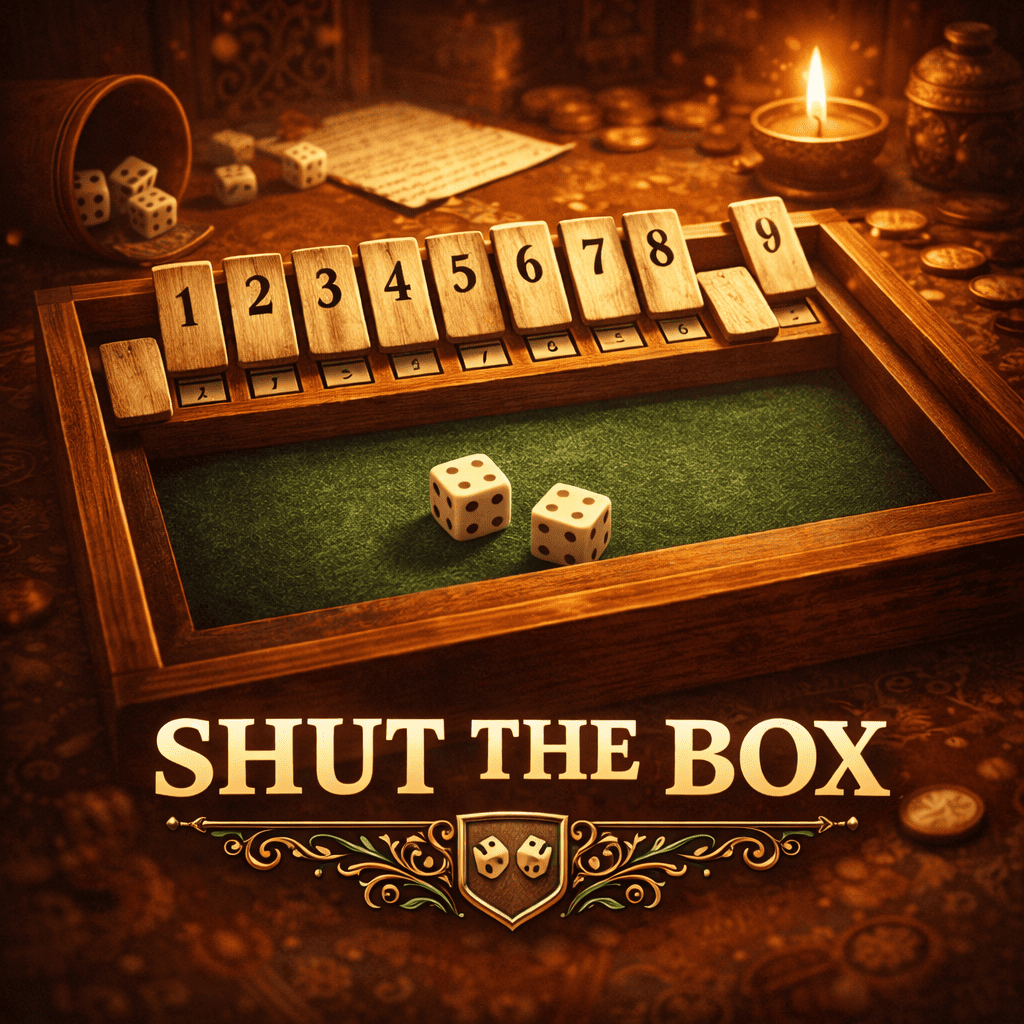
Shut the Box is a tidy little puzzle: roll two dice, then flip down any combination of the tiles 1–9 that sums to your roll — a 9 can close the 9, the 6+3, the 5+4 or the 2+3+4 — and your round ends when no combination fits. A round takes 2–5 minutes and your score is fixed when it ends. Farkle is one long escalating gamble: keep re-rolling non-scoring dice on the way to 10,000 points, knowing one bad roll erases the whole turn.
Where the decisions differ
Shut the Box has exactly one decision type: which tiles to flip for a given roll. The guideline is simple — prefer closing the high tiles (9, 8, 7) early, since they are the hardest to shut later and cost the most if left standing. Farkle's decision is riskier and repeats every roll: bank now or press on, weighing that a single remaining die scores only on a 1 or a 5 and busts two times in three. Farkle is the deeper gamble; Shut the Box the cleaner arithmetic.
Which fits your table?
Shut the Box is the better solo and casual game — genuinely fun alone, brilliant for children practising addition, and its wooden-box format has sat on pub counters since its 18th-century Normandy origins. Farkle needs a group to shine: the fun is watching someone refuse to bank 750 points and lose the lot. For a family night, run rounds of Shut the Box while dinner cooks and bring out Farkle when everyone is at the table.
Pick Shut the Box if…
- you want rounds that finish in under 5 minutes
- you sometimes play alone
- you want children practising mental addition
- you like classic wooden pub-game charm
Pick Farkle if…
- you want push-your-luck tension in a group
- you enjoy reading odds and pressing your advantage
- you have 3–8 players around the table
- you want a full game arc with a 10,000-point finish line
FAQ
How do you win Shut the Box?
Have the lowest total of unflipped tiles when your round ends — or flip all nine tiles, which 'shuts the box' for an instant win. In multiplayer, players take turns and compare final scores.
What does it mean to farkle?
To roll dice that contain no scorers — no 1s, no 5s, no triples or other scoring sets. A farkle ends your turn and wipes every point you had accumulated in it, which is the game's central threat.
Is Shut the Box good for children?
Excellent — it is addition drill in disguise. Decomposing a roll of 9 into 6+3 or 2+3+4 exercises exactly the number-bond skills schools teach around ages 5–7, and rounds are short enough to hold young attention.
Where does Shut the Box come from?
Tradition places it in ~18th-century Normandy, where fishermen and sailors played it in taverns for stakes. The tile-box format spread through Britain's pubs, and it remains a channel-coast pub staple today.
Is there any strategy in Farkle?
Yes — expected-value banking. Knowing that one die busts about 67% of the time and two dice about 44%, good players bank moderate totals rather than chase, and adjust their risk when trailing near the 10,000 finish.
Can you play Shut the Box on your own?
Yes, and it is one of the best solo dice games there is: play a round, record your score, try to beat it. Farkle, by contrast, loses its point without opponents to out-gamble.

MAIN MENU
PvP Games
 Battleship
 Crazy Eights
 Dots & Boxes Blitz
 Gomoku
 Ludo
Ludo Quoridor
 Snakes & Ladders
 Yahtzee
Free Games
 Alquerque
 Backgammon
 Bagh-Chal
 Balut
Balut Battle for TokyoBattleship
 Bingo
Bingo Brick Breaker
 Bridge
 Bunco
Bunco Callbreak
 Checkers
 Chess
Chess ChompCrazy Eights
 Cribbage
 Dara
Dara Derby Dash
 DominoesDots & Boxes Blitz
 Durak
Durak Emberdeep
 Euchre
 Fanorona
 Farkle
 Fox and Geese
 Fox and Hounds
 Generala
 Gin Rummy
 Go / WeiqiGomoku
 Hazard
 Hearts
 Hex
Hex Higher or Lower
 Hnefatafl
 Hounds and Jackals
 Indian Rummy
 Jungle
 Ludus Latrunculorum
 Liar's DiceLudo
 Mahjong Solitaire
 Mancala
 Minesweeper
 Nim
Nim Nine Men's Morris
 Onitama
 Patolli
 Peg Solitaire
 Pentago
 Pente
Pente Pig
Pig PylosQuoridor
 Reversi
 Royal Game of Ur
 Scratch Cards
 Seega
Seega Senet
Senet Shax
Shax Ship, Captain, Crew
 Shut the Box
 Sixteen Soldiers
 SnakeSnakes & Ladders
 Klondike Solitaire
 Space Blaster
 Spades
 Sugar Pop
 Sungka
 Tangram
 Tile Rummy
 Tower
Tower Truco
Truco War
War Word Spy
 XII ScriptaYahtzee
NEED HELP?