Board & Card Game Glossary
83 classic game terms, defined so they make sense on their own — with links to games where you can see each one in action.
Last reviewed
General Gaming Terms
- AI Opponent
- An AI opponent is a computer-controlled player that stands in for a human, usually with selectable difficulty levels. Modern AI opponents range from simple rule-based bots to engines that outplay world champions in chess and Go.See it in: chess, checkers, backgammon
- House Rules
- House rules are informal modifications to a game's official rules that a particular group agrees to play by. They range from bonus rewards on certain squares to altered scoring, and agreeing on them before play begins prevents mid-game disputes.See it in: ludo, crazy eights
- PvP
- PvP, short for player versus player, describes matches contested between human opponents rather than against computer-controlled ones. Online PvP play typically adds matchmaking, rankings, and real-time turns against people anywhere in the world.See it in: chess, backgammon, spades
- Single-Player
- Single-player describes a game or mode played by one person against a puzzle, a score target, or the game system itself rather than another human. Classic examples include Peg Solitaire and modern arcade score-chasers.See it in: peg solitaire, snake, word spy
- Tiebreaker
- A tiebreaker is a predefined rule for producing a single winner when players finish with equal scores. Common tiebreakers include comparing a secondary score, playing a sudden-death round, or awarding the win to whoever reached the shared score first.See it in: yahtzee, spades
- Turn Order
- Turn order is the sequence in which players take their moves. Many games set it with an opening roll or draw, and because moving first often carries a measurable edge, some games add compensation for later players, such as komi in Go.See it in: ludo, backgammon, go
- Variant
- A variant is an alternative version of a game that changes rules, setup, or win conditions while keeping the core identity intact. Crazy Eights, for example, circulates in dozens of variants that assign different powers to the special cards.See it in: crazy eights, checkers
Board Game Terms
- Anchor
- An anchor is a point in the opponent's home board occupied by two or more of your checkers in backgammon. Anchors give checkers hit later in the game a safe landing spot and form the backbone of holding-game and back-game strategies.See it in: backgammon
- Atari
- Atari is a Go term for a stone or group that has only one liberty remaining and will be captured on the next move unless it escapes or gains liberties. It is loosely comparable to check in chess.See it in: go
- Bear Off
- Bearing off is the final stage of backgammon, in which a player removes checkers from the board according to dice rolls once all fifteen of their checkers have reached their home board. The first player to bear off all fifteen checkers wins.See it in: backgammon, xii scripta
- Blot
- A blot is a single checker sitting alone on a backgammon point, exposed to being hit. If an opposing checker lands on it, the blot is sent to the bar and must re-enter the game in the opponent's home board.See it in: backgammon
- Casting Sticks
- Casting sticks are flat throwing sticks with two distinguishable faces that served as dice in ancient race games such as Senet and Hounds and Jackals. Players throw a set of sticks and count how many land marked-side up to determine movement.See it in: senet, hounds and jackals, royal game of ur
- Castling
- Castling is the only chess move that relocates two pieces at once: the king moves two squares toward a rook and that rook jumps to the square the king crossed. It is legal only if neither piece has moved, the squares between them are empty, and the king does not start in, pass through, or land on an attacked square.See it in: chess
- Checkmate
- Checkmate is the position that ends a chess game: the king is under attack and no legal move can eliminate the threat. Delivering checkmate wins immediately, regardless of the material remaining on the board.See it in: chess
- Custodian Capture
- Custodian capture removes an enemy piece by flanking it on two opposite sides with your own pieces. It is the defining capture method of ancient games such as Roman Latrunculi and Viking Hnefatafl, where pieces are sandwiched rather than jumped or landed on.See it in: hnefatafl, latrunculi
- En Passant
- En passant is a special chess capture available when an enemy pawn advances two squares from its starting rank and lands directly beside your pawn. Your pawn may capture it as though it had moved only one square, but the right expires if not used immediately.See it in: chess
- Forced Capture
- Forced capture is a rule that obliges a player to make a capturing move whenever one is available. It is standard in checkers, where jumps are compulsory, and in Fanorona; deliberately feeding a piece into a forced capture is a core sacrificial tactic.See it in: checkers, fanorona
- Fork
- A fork is a single move that attacks two or more enemy pieces at the same time, so the opponent can save only one of them. In chess the knight is the most feared forking piece because its attacks cannot be blocked.See it in: chess
- Gambit
- A gambit is an opening in which a player deliberately offers material, most often a pawn, in exchange for faster development, open lines, or attacking chances. The Queen's Gambit and King's Gambit are the classic chess examples.See it in: chess
- Gammon
- A gammon is a backgammon win worth double the stake, scored when the loser has not borne off a single checker. If the loser also has a checker on the bar or in the winner's home board, the win is a backgammon and is worth triple.See it in: backgammon
- King (Crowning)
- In checkers, a piece that reaches the opponent's back rank is crowned a king, traditionally marked by stacking a second checker on top. Unlike ordinary men, kings may move and capture both forward and backward.See it in: checkers
- Ko
- Ko is a Go rule that forbids a move which would recreate the board position of the previous turn. It prevents endless single-stone recapture loops and gives rise to ko fights, in which players make threats elsewhere on the board to earn the right to retake.See it in: go
- Komi
- Komi is the point compensation added to White's score in Go to offset Black's advantage of moving first. Modern komi is commonly 6.5 points under Japanese rules or 7.5 under Chinese rules, with the half point also preventing drawn games.See it in: go
- Liberty
- A liberty is an empty intersection directly adjacent to a stone or connected group of stones in Go. A group is captured and removed from the board the moment its last liberty is filled by the opponent.See it in: go
- Mill
- A mill is a row of three of your pieces along a marked line in Nine Men's Morris. Completing a mill entitles you to remove one opposing piece from the board, and strong players build formations that can open and close a mill on successive turns.See it in: nine mens morris, dara
- Pin
- A pin is a chess tactic in which a piece cannot move, or should not move, because a more valuable piece stands behind it on the same line of attack. A pin against the king is absolute: the pinned piece may not legally move at all.See it in: chess
- Pip
- A pip is a single spot on a die or domino, and by extension a unit of movement in race games. In backgammon the pip count is the total number of points a player's checkers must still travel to bear off, and comparing pip counts reveals who leads the race.See it in: backgammon, dominoes
- Point (Backgammon)
- A point is one of the 24 narrow triangles on a backgammon board where checkers land and rest. Occupying a point with two or more checkers "makes" the point and blocks opposing checkers from landing there.See it in: backgammon
- Rosette
- A rosette is a specially marked square on the board of the Royal Game of Ur, a Mesopotamian race game more than 4,000 years old. Landing on a rosette grants an extra roll, and in most reconstructions a piece resting on one is safe from capture.See it in: royal game of ur, senet
- Skewer
- A skewer is a chess tactic in which a valuable piece is attacked along a line and, when it moves out of danger, a less valuable piece standing behind it is captured. It is often described as a pin in reverse.See it in: chess
- Stalemate
- Stalemate is a chess position in which the player to move is not in check but has no legal move. Under standard rules stalemate is a draw, which makes engineering one a vital defensive resource in otherwise lost endgames.See it in: chess
- Territory
- Territory is the empty area of the board surrounded and controlled by one player's stones in Go. At the end of the game each empty intersection of territory is worth one point, and the player with more territory plus captures, adjusted by komi, wins.See it in: go
- Zugzwang
- Zugzwang is a situation in which a player would prefer to pass but is compelled to move, and every legal move makes their position worse. It is a decisive weapon in chess endgames, where the obligation to move can drag a king off a critical square.See it in: chess
- Tan
- A tan is one of the seven flat pieces of a tangram set: five right triangles, one square and one parallelogram, all cut from a single larger square. Every tan must be used, laid flat and non-overlapping, in a valid tangram solution.See it in: tangram, peg solitaire
- Dissection Puzzle
- A dissection puzzle asks you to rearrange a fixed set of flat pieces into a target outline, using every piece without overlaps. Tangram is the best-known example; the pieces never change, only the silhouette you are asked to fill.See it in: tangram
- Hunt Game
- A hunt game is an asymmetric board game where a small, powerful force chases a larger, weaker one. Fox and Geese, Bagh-Chal and the Norse tafl games are the classic examples, usually played twice with the sides swapped.See it in: fox and geese, bagh chal, hnefatafl
- Dou Shou Qi
- Dou Shou Qi (鬥獸棋), roughly "Game of Fighting Animals", is the Chinese board game sold in English as Jungle or Animal Chess. Two players command eight animals ranked from elephant down to rat on a 7x9 board, and an animal captures any enemy of equal or lower rank.See it in: jungle, chess
- Jare
- A jare is a mill — three pieces in a line — formed during the placement phase of Shax, the Somali twelve-piece morris game. Unlike a mill in Nine Men’s Morris it captures nothing at the time; the player who makes the first jare simply earns the right to remove an enemy piece first once every point on the board is filled.See it in: shax, nine mens morris
- Relay Sowing
- Relay sowing is a mancala rule where a turn continues instead of ending: if your last seed lands in a hole that already contained seeds, you pick that whole hole up and keep sowing. It is the defining rule of Sungka and is what makes its turns far longer than Kalah-style mancala.See it in: sungka, mancala
- Head (Mancala)
- The head is the large store hole at each end of a Sungka board where captured seeds are banked. Players drop a seed into their own head each time they pass it while sowing but never into the opponent’s, and whoever finishes with more seeds in their head wins.See it in: sungka, mancala
- Sholo Guti
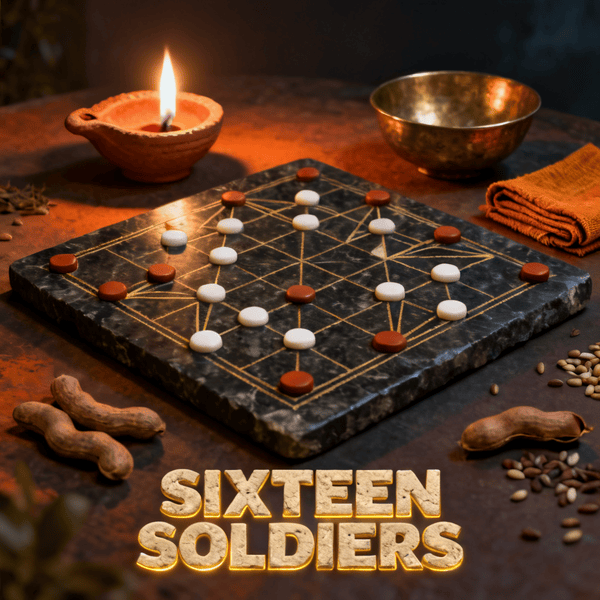
- Sholo guti, meaning "sixteen pieces", is the Bangladeshi name for the game known in English as Sixteen Soldiers. Each side has sixteen pieces on a 37-point board — a 5x5 lattice with two triangular extensions — and captures by short leaps in any direction. The same game is called cows and leopards in parts of India.See it in: sixteen soldiers, alquerque
Dice Game Terms
- Banking
- Banking means voluntarily ending your turn in a push-your-luck dice game to lock in the points scored so far that turn. In Pig, a player banks by choosing to hold; rolling a 1 before banking loses every unbanked point from the turn.See it in: pig, farkle
- Doubling Cube
- The doubling cube is a six-faced backgammon accessory marked 2, 4, 8, 16, 32, and 64 that tracks the stakes of the current game. A player who believes they are ahead may offer a double before rolling; the opponent must either accept the cube at twice the stakes or concede the game at its current value.See it in: backgammon
- Farkle
- A farkle is a roll that contains no scoring dice in the dice game of the same name. Farkling ends the turn immediately and wipes out every point accumulated during that turn, making it the central risk in the game's push-your-luck decisions.See it in: farkle, pig
- Full House
- A full house is a dice combination of three of a kind plus a pair, such as 5-5-5-2-2. It scores a flat 25 points in Yahtzee and is also a named scoring category in Generala and Balut.See it in: yahtzee, generala, balut
- Main
- The main is the number from 5 to 9 that the caster calls before throwing in Hazard, the medieval English dice game; it defines which rolls win instantly ("nicks") and which lose outright ("outs"). Craps descends directly from Hazard, with the main permanently fixed at 7.See it in: hazard
- Push Your Luck
- Push your luck is a game mechanic in which a player repeatedly chooses between banking what they have already earned and risking it all for a bigger score. Dice games such as Pig and Farkle are built entirely on this tension between greed and safety.See it in: pig, farkle, higher lower
- Shut the Box
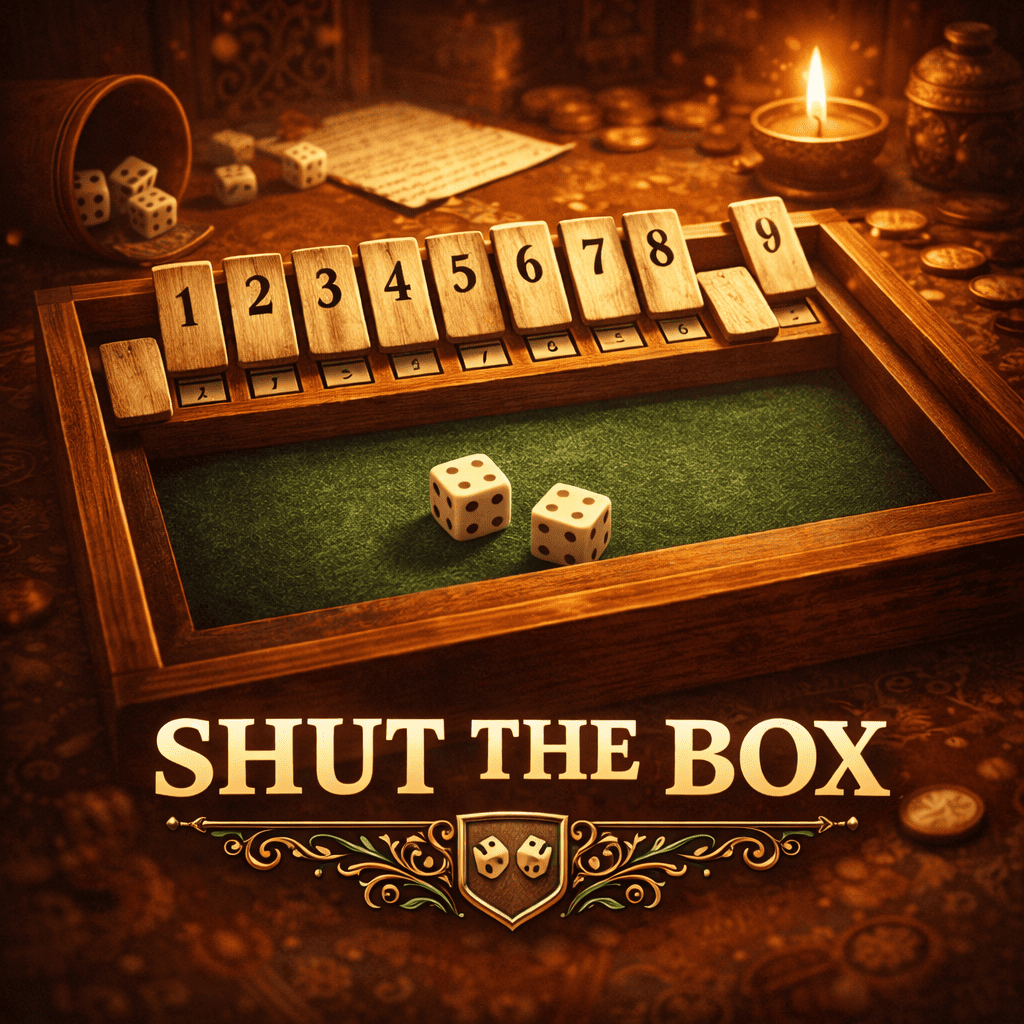
- Shut the Box is a traditional dice game in which players roll two dice and flip down numbered tiles, usually 1 through 9, whose values sum to the roll. Closing every tile "shuts the box" for an outright win; otherwise the total of the tiles left open counts against the player.See it in: shut the box
- Straight (Small/Large)
- A straight is a run of consecutive values across several dice. In Yahtzee a small straight is any four values in sequence and scores 30 points, while a large straight is five in sequence for 40; Generala and Balut score straights under their own point values.See it in: yahtzee, generala, balut
- Yahtzee (Five of a Kind)
- A Yahtzee is five dice all showing the same value, the highest-scoring roll in the game of the same name, worth 50 points. The equivalent five-of-a-kind roll is called a generala in Generala, where one thrown in a single roll can win the game outright.See it in: yahtzee, generala, balut
Card Game Terms
- Bid
- A bid is a declaration of how many tricks or points a player or partnership commits to winning in the coming hand. In Spades each player bids a number of tricks, and a partnership that meets its combined bid scores 10 points per bid trick.See it in: spades, bridge
- Crib
- The crib is an extra four-card hand in cribbage, built from two discards by each player and scored by the dealer after the main hands. Because only the dealer scores the crib, the non-dealer tries to discard cards that are unlikely to combine well.See it in: cribbage
- Discard Pile
- The discard pile is the face-up stack of cards that players have played or thrown away. In Crazy Eights the top discard determines what may legally be played next, and in many Rummy games players may draw from the discard pile instead of the stock.See it in: crazy eights, indian rummy, durak
- Envido
- Envido is a betting round in the South American card game Truco, contested over who holds the highest count of same-suit cards. Two cards of one suit score their combined values plus 20, making 33 the highest possible envido.See it in: truco
- Finesse
- A finesse is a trick-taking technique that attempts to win a trick with a card lower than the best one still outstanding, by betting on where the missing honor sits. A classic bridge finesse leads toward an ace-queen combination and plays the queen, hoping the king lies with the opponent who has already played.See it in: bridge
- Follow Suit
- To follow suit is to play a card of the same suit as the card that led the trick. Most trick-taking games, including Spades and Bridge, make following suit mandatory whenever possible; only a player with a void may play a different suit.See it in: spades, bridge
- Meld
- A meld is a group of cards that may be scored or laid down together, typically three or more of a kind or a run in a single suit. Building melds is the central goal of the Rummy family, from Indian Rummy to tile-based relatives such as Mahjong.See it in: indian rummy, tile rummy, mahjong
- Nil Bid
- A nil bid is a bid of zero tricks in Spades, a promise that the bidder will win no tricks at all during the hand. A successful nil typically earns a 100-point bonus, while taking even a single trick costs the same amount.See it in: spades
- Pegging
- Pegging is the play phase of cribbage, in which players alternate laying cards and immediately score points for pairs, runs, and running totals of exactly 15 or 31. The name comes from recording scores by moving pegs along the board toward the game-winning 121st hole.See it in: cribbage
- Rubber
- A rubber is a match unit in bridge won by the first partnership to take two games, each game requiring 100 points from contracts bid and made. Winning the rubber earns a bonus of 700 points if the opponents took no game, or 500 if they took one.See it in: bridge
- Ruff
- To ruff is to win a trick by playing a trump card when you cannot follow suit. Deliberately creating a void so you can ruff is a standard way to manufacture extra tricks in bridge and Spades.See it in: bridge, spades
- Stock
- The stock is the face-down pile of undealt cards from which players draw during a game. Rummy players take a card from the stock or the discard pile each turn, while in Durak players refill their hands from the stock after every bout.See it in: durak, indian rummy, crazy eights
- Trick
- A trick is one round of play in a card game in which each player in turn contributes a single card, and the best card by the game's rules wins the trick for its player. The winner usually collects the cards and leads the next trick.See it in: spades, bridge
- Trick-Taking
- Trick-taking describes the family of card games organized around winning tricks, rounds in which every player plays exactly one card. Bridge, Spades, and Truco are all trick-taking games, and the family is among the oldest in card play.See it in: spades, bridge, truco
Strategy & Theory
- Branching Factor
- Branching factor is the average number of legal moves available from a position in a game. Chess has a branching factor of roughly 35 while Go's is around 250, which is a major reason Go resisted strong computer play for decades longer than chess.See it in: chess, go
- Endgame
- The endgame is the final phase of a strategy game, after most forces have been exchanged and the position has simplified. In chess it is the stage where kings become active attacking pieces and promoting a pawn often decides the result.See it in: chess, checkers
- Luck vs. Skill Ratio
- The luck-versus-skill ratio describes how much of a game's outcome is decided by chance rather than by player decisions. Chess sits at the pure-skill extreme and War at the pure-luck extreme, while dice games such as backgammon reward skill reliably only across many games.See it in: chess, war, backgammon
- Midgame
- The midgame, also called the middlegame, is the phase between the opening and the endgame, when both sides have developed their forces and the main fight for advantage takes place. Plans, tactics, and piece coordination dominate this stage.See it in: chess, go
- Misère Play
- Misère play inverts a game's normal winning condition: the player forced to take the last object wins in normal play but loses in misère play. Misère Nim, famously played with matchsticks in the film Last Year at Marienbad, is the best-known example, and its correct strategy differs from normal Nim only in the final moves.See it in: nim
- Nim-Sum
- The nim-sum is the binary XOR of all the heap sizes in Nim. Charles Bouton proved in 1901 that a position is losing for the player about to move exactly when its nim-sum is zero, which gives Nim a complete winning strategy: always move so the nim-sum you leave behind is zero.See it in: nim, chomp
- Opening
- The opening is the first phase of a strategy game, covering the early moves in which players develop their pieces and stake claims on the board. Chess openings are studied so deeply that established sequences carry names, such as the Sicilian Defence.See it in: chess, go
- Perfect Information
- A game of perfect information is one in which every player can see the complete state of play at all times, with no hidden hands, face-down decks, or simultaneous moves. Chess, Go, and checkers are perfect-information games; most card games are not.See it in: chess, go, checkers
- Positional Play
- Positional play is a strategic style built on long-term advantages such as piece placement, structure, and control of key squares, rather than immediate tactical strikes. Positional players accumulate small edges that later convert into winning attacks or endgames.See it in: chess, go
- Sacrifice
- A sacrifice is the deliberate surrender of material in exchange for a positional, tactical, or timing advantage. Sacrifices range from a chess gambit pawn given up for faster development to a checkers piece fed into a forced capture to set up a multiple jump.See it in: chess, checkers
- Solved Game
- A solved game is one whose result under perfect play by both sides has been mathematically proven. Checkers was solved in 2007 and is a draw with best play; Nine Men's Morris is likewise a proven draw, while Pentago is a proven first-player win.See it in: checkers, nine mens morris, pentago
- Strategy-Stealing Argument
- A strategy-stealing argument is a non-constructive proof that the first player in a game has a winning strategy: if the second player had one, the first player could make an irrelevant opening move and then "steal" that strategy as their own. It proves the first player wins Chomp and Hex without revealing what the winning moves actually are.See it in: chomp, hex, gomoku
- Tempo
- Tempo is the currency of time in strategy games, where one tempo equals one useful move. Gaining a tempo means forcing the opponent to waste a turn, for example by developing a piece while making a threat, and repeated losses of tempo surrender the initiative.See it in: chess, backgammon
- Zero-Sum
- A zero-sum game is one in which the players' gains and losses always balance to zero, so anything one player wins another must lose. Nearly all classic head-to-head board and card games, from chess to backgammon, are zero-sum.See it in: chess, backgammon
- Zwischenzug
- A zwischenzug, German for "in-between move", is a surprise move interposed before an apparently forced reply, typically a check or a sharp threat that must be answered first. It often turns a routine exchange into a winning tactic.See it in: chess
- Asymmetric Game
- An asymmetric game gives the two sides different forces, abilities or win conditions. In Fox and Geese one fox can jump and capture while thirteen geese cannot capture at all — so the sides are playing genuinely different problems.See it in: fox and geese, hnefatafl, bagh chal
- Rank Ladder
- A rank ladder is a capture system where every piece carries a number and may take any enemy of equal or lower rank, rather than being distinguished by how it moves. Jungle is the classic example, and it deliberately loops the ladder so the lowest piece, the rat, can capture the highest, the elephant.See it in: jungle

MAIN MENU
HomeJackpotsMultiplayerRoomsCreate RoomMy RoomPlayersLeaderboard
All Games Battleship
 Crazy Eights
 Dots & Boxes Blitz
 Gomoku
 Ludo
Ludo Quoridor
 Snakes & Ladders
 Yahtzee
 Alquerque
 Backgammon
 Bagh-Chal
 Balut
Balut Battle for TokyoBattleship
 Bingo
Bingo Brick Breaker
 Bridge
 Bunco
Bunco Callbreak
 Checkers
 Chess
Chess ChompCrazy Eights
 Cribbage
 Dara
Dara Derby Dash
 DominoesDots & Boxes Blitz
 Durak
Durak Emberdeep
 Euchre
 Fanorona
 Farkle
 Fox and Geese
 Fox and Hounds
 Generala
 Gin Rummy
 Go / WeiqiGomoku
 Hazard
 Hearts
 Hex
Hex Higher or Lower
 Hnefatafl
 Hounds and Jackals
 Indian Rummy
 Jungle
 Ludus Latrunculorum
 Liar's DiceLudo
 Mahjong Solitaire
 Mancala
 Minesweeper
 Nim
Nim Nine Men's Morris
 Onitama
 Patolli
 Peg Solitaire
 Pentago
 Pente
Pente Pig
Pig PylosQuoridor
 Reversi
 Royal Game of Ur
 Scratch Cards
 Seega
Seega Senet
Senet Shax
Shax Ship, Captain, Crew
 Shut the Box
 Sixteen Soldiers
 SnakeSnakes & Ladders
 Klondike Solitaire
 Space Blaster
 Spades
 Sugar Pop
 Sungka
 Tangram
 Tile Rummy
 Tower
Tower Truco
Truco War
War Word Spy
 XII ScriptaYahtzee
PvP Games
BattleshipCrazy EightsDots & Boxes BlitzGomokuLudoQuoridorSnakes & LaddersYahtzeeFree Games
AlquerqueBackgammonBagh-ChalBalutBattle for TokyoBattleshipBingoBrick BreakerBridgeBuncoCallbreakCheckersChessChompCrazy EightsCribbageDaraDerby DashDominoesDots & Boxes BlitzDurakEmberdeepEuchreFanoronaFarkleFox and GeeseFox and HoundsGeneralaGin RummyGo / WeiqiGomokuHazardHeartsHexHigher or LowerHnefataflHounds and JackalsIndian RummyJungleLudus LatrunculorumLiar's DiceLudoMahjong SolitaireMancalaMinesweeperNimNine Men's MorrisOnitamaPatolliPeg SolitairePentagoPentePigPylosQuoridorReversiRoyal Game of UrScratch CardsSeegaSenetShaxShip, Captain, CrewShut the BoxSixteen SoldiersSnakeSnakes & LaddersKlondike SolitaireSpace BlasterSpadesSugar PopSungkaTangramTile RummyTowerTrucoWarWord SpyXII ScriptaYahtzeeNEED HELP?