Backgammon vs Chess: Luck, Skill & Which to Learn
The Verdict
Play backgammon if you want fast games where luck keeps every match tense but skill wins over a session — 5–15 minutes per game, dice, and the doubling cube. Play chess if you want pure, perfect-information strategy with zero luck. A backgammon novice can beat a strong player in any single game; in chess, virtually never.
Side by Side
| Backgammon | Chess | |
|---|---|---|
| Players | 2 | 2 |
| Average game length | 5–15 min per game | 25–60 min |
| Luck vs skill | Dice luck per game; skill wins matches | 100% skill |
| Rules complexity | ~15 min to learn | ~30–60 min to learn |
| Randomness | 2 dice + doubling cube | None |
| Strategic depth | Probability, priming, cube equity | Unsolved; ~10^120 possible games |
| Age suitability | 6+ | 7+ |
| First appeared | Tables family ~5,000 yrs; modern rules 17th c. | ~6th c. India (chaturanga) |
Luck versus perfect information
Backgammon injects luck every turn: two dice decide your options, so a well-played game can still be lost. Over a match, though, the luck averages out — that is why backgammon is played to match scores and why the doubling cube exists, letting a confident player raise the stakes mid-game. Chess has no hidden information and no randomness; the better player wins with brutal consistency, which is motivating at the top and punishing at the bottom.
What each game trains
Backgammon trains probability: pip counting, working out the odds of being hit (any given number appears on at least one of two dice 11 times in 36), and judging racing games against positional priming games. Cube decisions add a layer of equity judgement close to gambling theory. Chess trains calculation, memory and long-term planning. There is modest overlap — both reward pattern recognition — but backgammon is closer to poker in spirit, chess closer to mathematics.
Which is easier to learn?
Backgammon. Its rules — race your 15 checkers home and bear them off, hitting lone blots on the way — take about 15 minutes, and the dice keep beginners competitive against stronger players. Chess demands more up-front learning and offers no such mercy. Mastery inverts the picture less than you might think: world-class backgammon, especially cube play, is genuinely hard, but the chess skill ceiling is higher still.
Pick Backgammon if…
- you want fast games of 5–15 minutes with built-in drama
- you enjoy probability and calculated risk over pure calculation
- you want a social game where beginners still win sometimes
- you like the gambling edge the doubling cube brings
Pick Chess if…
- you want a game where the better player reliably wins
- you enjoy deep study — openings, tactics, endgames
- you want the largest competitive player pool of any board game
- you dislike losing to lucky dice
FAQ
Is backgammon more luck than skill?
Per game, luck is significant — the dice can decide any single game. Over a session or match, skill dominates: strong players make better cube decisions and consistently better checker plays, which is why the same names keep winning tournaments.
Is backgammon older than chess?
Yes, by a wide margin. The tables family behind backgammon reaches back ~5,000 years to Mesopotamian race games, while chess descends from chaturanga in ~6th-century India. Backgammon's modern rules and name settled in 17th-century England.
What is the doubling cube?
A die marked 2, 4, 8, 16, 32 and 64, introduced in 1920s New York. A player who believes they are ahead can offer to double the stakes; the opponent must accept or forfeit the game. It is widely considered backgammon's deepest skill element.
Should I learn chess or backgammon first?
Backgammon if you want to play enjoyably this week and prefer a fast, social game; chess if you want a long-term study project. Many players keep both: backgammon for casual sessions, chess for deep focus.
Can a beginner beat an expert at backgammon?
In one game, absolutely — hot dice can beat perfect play. Across a long match the expert's edge compounds and a beginner's chances fall towards zero. In chess, a beginner effectively never beats an expert.

MAIN MENU
PvP Games
 Battleship
 Crazy Eights
 Dots & Boxes Blitz
 Gomoku
 Ludo
Ludo Quoridor
 Snakes & Ladders
 Yahtzee
Free Games
 Alquerque
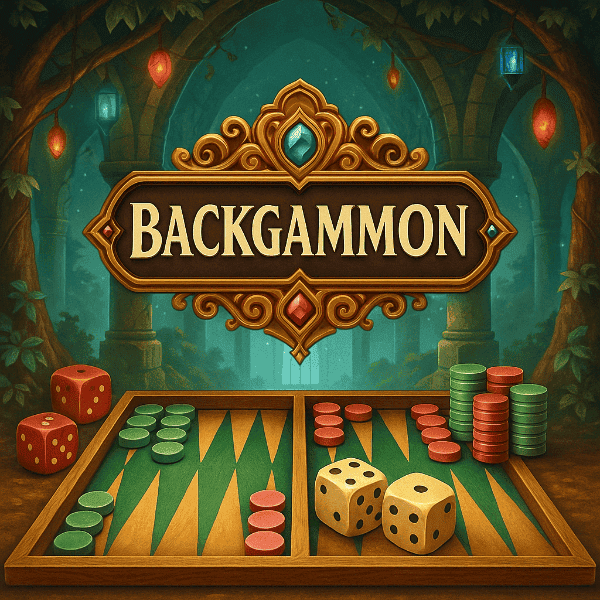 Backgammon
 Bagh-Chal
 Balut
Balut Battle for TokyoBattleship
 Bingo
Bingo Brick Breaker
 Bridge
 Bunco
Bunco Callbreak
 Checkers
 Chess
Chess ChompCrazy Eights
 Cribbage
 Dara
Dara Derby Dash
 DominoesDots & Boxes Blitz
 Durak
Durak Emberdeep
 Euchre
 Fanorona
 Farkle
 Fox and Geese
 Fox and Hounds
 Generala
 Gin Rummy
 Go / WeiqiGomoku
 Hazard
 Hearts
 Hex
Hex Higher or Lower
 Hnefatafl
 Hounds and Jackals
 Indian Rummy
 Jungle
 Ludus Latrunculorum
 Liar's DiceLudo
 Mahjong Solitaire
 Mancala
 Minesweeper
 Nim
Nim Nine Men's Morris
 Onitama
 Patolli
 Peg Solitaire
 Pentago
 Pente
Pente Pig
Pig PylosQuoridor
 Reversi
 Royal Game of Ur
 Scratch Cards
 Seega
Seega Senet
Senet Shax
Shax Ship, Captain, Crew
 Shut the Box
 Sixteen Soldiers
 SnakeSnakes & Ladders
 Klondike Solitaire
 Space Blaster
 Spades
 Sugar Pop
 Sungka
 Tangram
 Tile Rummy
 Tower
Tower Truco
Truco War
War Word Spy
 XII ScriptaYahtzee
NEED HELP?