Spades vs Bridge: Which Trick-Taking Game to Learn?
The Verdict
Learn Spades if you want partnership trick-taking you can play tonight: spades are always trump, bidding is a simple trick count, and one hand takes 10 minutes. Learn Bridge if you want the deepest card game ever formalised — a bidding language with conventions, dummy play, and a competitive scene that rewards decades of study.
Side by Side
| Spades | Bridge | |
|---|---|---|
| Players | 4 (2 partnerships) | 4 (2 partnerships) |
| Average game length | 30–60 min to 500 points | ~7 min per deal; sessions 1–4 hrs |
| Luck vs skill | Card luck; strong play skill | Luck largely neutralised in duplicate play |
| Rules complexity | ~15 min to learn | Weeks; bidding systems take months |
| Trump suit | Always spades | Set by the auction each deal |
| Bidding | Plain trick count, plus nil | Coded auction language with conventions |
| Age suitability | 8+ | 12+ |
| First appeared | 1930s USA | 1925 contract bridge (from whist via 1880s–1900s bridge games) |
Same skeleton, different scale
Both are four-player partnership trick-taking games from the whist family: deal 13 cards each, bid on how many tricks you will win, then follow suit and count. Spades keeps everything fixed — spades are always trump, and your bid is a plain number of tricks, with nil as the one exotic call. Bridge makes the auction itself the game: partners bid in a coded language to find the best contract, trump suit included, and then one hand (the dummy) plays face up.
The learning curve gap
Spades is playable within an evening: 15 minutes of rules, a few hands to calibrate bidding, done. Bridge is a genuine study project — basic bidding systems such as Acol or Standard American take weeks, conventions accumulate for years, and duplicate scoring adds another layer. The payoff is proportional: duplicate bridge largely factors luck out by comparing your result with others holding identical cards, and offers arguably the deepest partnership gameplay of any card game.
Skill transfer
Everything you learn about card play in Spades — counting trumps, tracking discards, finessing, reading distribution from the bidding — transfers directly to bridge declarer play and defence. That makes Spades an excellent on-ramp, and many bridge teachers recommend trick-taking experience first. The reverse also holds: bridge players pick up Spades in minutes and tend to dominate on card play, though nil-bid judgement and the different scoring rhythm take a few sessions to absorb.
Pick Spades if…
- you want to be playing competent hands tonight
- you enjoy trick-taking without memorising conventions
- you like the drama of nil bids and bags
- you play casually with family or online
Pick Bridge if…
- you want a card game you can study for decades
- you enjoy partnership communication and coded bidding
- you want organised competition — clubs, duplicate, tournaments
- you prefer skill to decide results, not the deal
FAQ
Is Spades easier than Bridge?
Much easier. Spades has a fixed trump suit and a plain-number bid, learnable in 15 minutes. Bridge adds a coded auction, contract scoring and dummy play — most people need weeks of study before their first comfortable session.
Did Spades come from Bridge?
Both come from the whist family. Spades emerged in the 1930s USA — popularised by soldiers in the Second World War — as a faster, simpler cousin of the bridge-style games of the era, rather than as a direct descendant of contract bridge.
What is a nil bid in Spades?
A bid to win zero tricks that hand. Succeed and your team typically scores a 100-point bonus; take even one trick and you suffer the same as a penalty. It is Spades' signature high-risk play.
Why is Bridge considered so hard?
The bidding. Bridge auctions are a constrained language in which each call must describe your hand to your partner, and conventions multiply the vocabulary. Card play is learnable quickly; bidding judgement takes years.
Who invented contract bridge?
Harold Vanderbilt codified contract bridge's scoring in 1925 during a cruise, building on auction bridge (~1904) and earlier bridge-whist from the 1880s–90s. His version displaced the alternatives within a decade.
Can learning Spades help with Bridge?
Yes. Trick play, trump management and counting cards transfer directly, so Spades players start bridge with the play of the hand half-learned. Only the bidding system remains a fresh mountain to climb.

MAIN MENU
PvP Games
 Battleship
 Crazy Eights
 Dots & Boxes Blitz
 Gomoku
 Ludo
Ludo Quoridor
 Snakes & Ladders
 Yahtzee
Free Games
 Alquerque
 Backgammon
 Bagh-Chal
 Balut
Balut Battle for TokyoBattleship
 Bingo
Bingo Brick Breaker
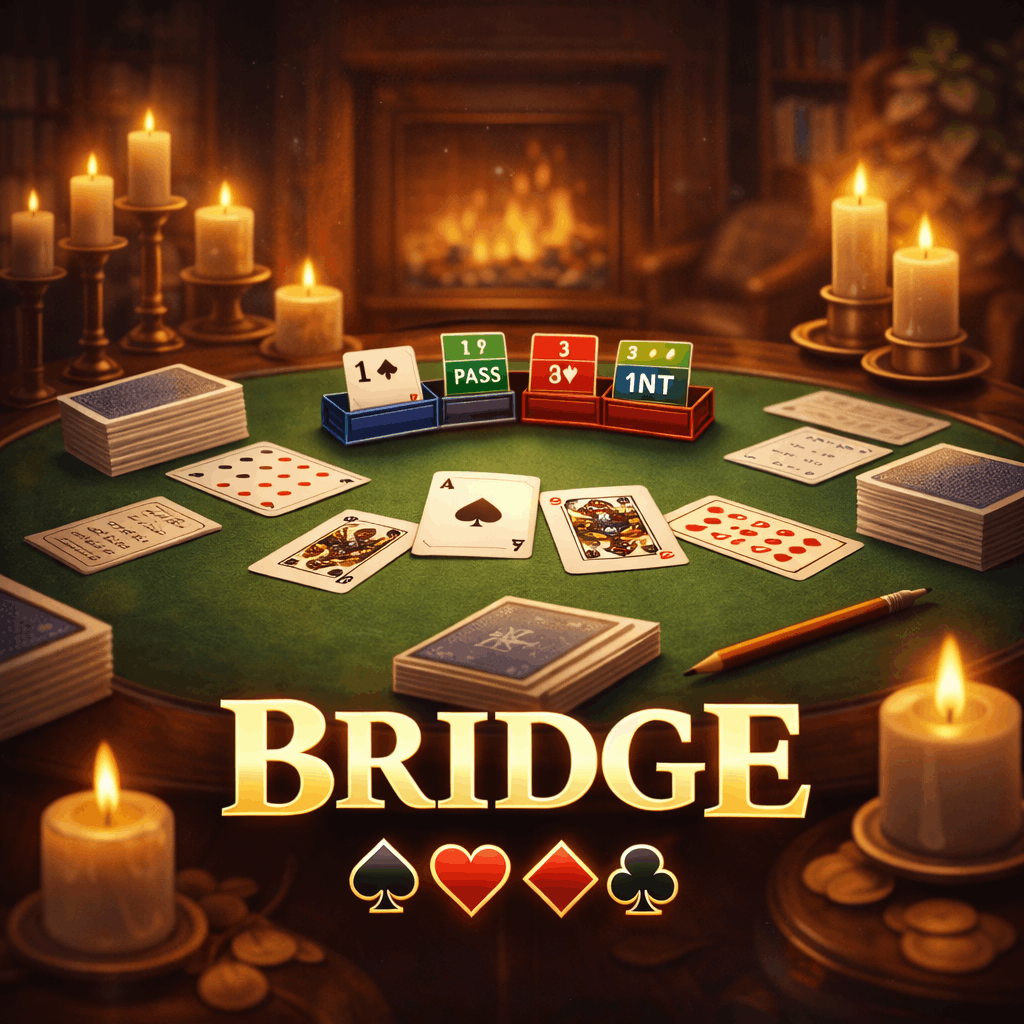 Bridge
 Bunco
Bunco Callbreak
 Checkers
 Chess
Chess ChompCrazy Eights
 Cribbage
 Dara
Dara Derby Dash
 DominoesDots & Boxes Blitz
 Durak
Durak Emberdeep
 Euchre
 Fanorona
 Farkle
 Fox and Geese
 Fox and Hounds
 Generala
 Gin Rummy
 Go / WeiqiGomoku
 Hazard
 Hearts
 Hex
Hex Higher or Lower
 Hnefatafl
 Hounds and Jackals
 Indian Rummy
 Jungle
 Ludus Latrunculorum
 Liar's DiceLudo
 Mahjong Solitaire
 Mancala
 Minesweeper
 Nim
Nim Nine Men's Morris
 Onitama
 Patolli
 Peg Solitaire
 Pentago
 Pente
Pente Pig
Pig PylosQuoridor
 Reversi
 Royal Game of Ur
 Scratch Cards
 Seega
Seega Senet
Senet Shax
Shax Ship, Captain, Crew
 Shut the Box
 Sixteen Soldiers
 SnakeSnakes & Ladders
 Klondike Solitaire
 Space Blaster
 Spades
 Sugar Pop
 Sungka
 Tangram
 Tile Rummy
 Tower
Tower Truco
Truco War
War Word Spy
 XII ScriptaYahtzee
NEED HELP?