XII Scripta vs Backgammon: The Roman Ancestor Compared
The Verdict
Play backgammon for the refined, competitive experience: 2 dice, the doubling cube, and 5,000 years of iteration behind precise modern rules. Play XII Scripta to feel the Roman original — 3 dice, a 3×12 board often carved as letters, and reconstructed rules with rougher edges. Backgammon is XII Scripta's descendant via the later Roman game tabula.
Side by Side
| XII Scripta | Backgammon | |
|---|---|---|
| Players | 2 | 2 |
| Board | 3 rows × 12 points (36 spaces) | 24 points in 2 rows of 12 |
| Dice | 3 | 2, plus doubling cube |
| Pieces | 15 per player | 15 per player |
| Average game length | 15–30 min | 5–15 min per game |
| Rules certainty | Reconstructed; no rulebook survives | Fully standardised |
| Luck vs skill | Heavy dice luck | Dice luck; skill dominates matches |
| First appeared | Rome, ~1st c. BC | Tables lineage ~5,000 yrs; modern form 17th c. England |
From three rows to two
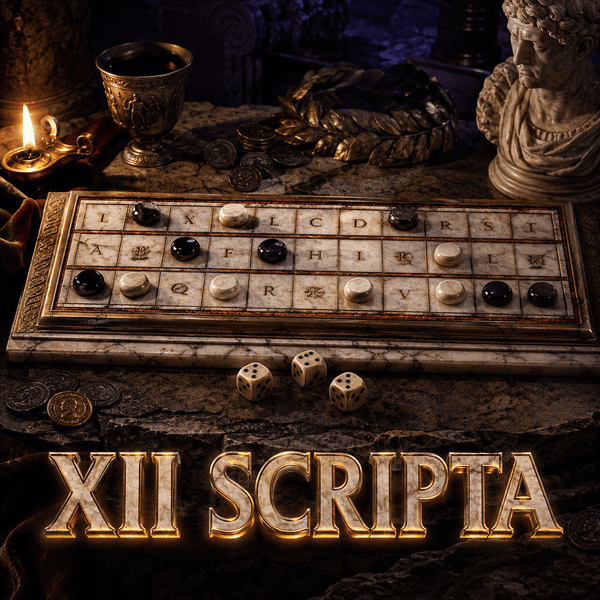
XII Scripta — ludus duodecim scriptorum, 'the game of twelve markings' — raced 15 pieces per player around three rows of 12 points, using three dice; Roman boards often disguise the grid as six six-letter words. By late antiquity the middle row had been dropped, producing tabula: two rows of 12 points, the exact geometry of a backgammon board. The tables family then spread across the medieval world, settling into the game named backgammon in 17th-century England.
What playing them feels like
Reconstructed XII Scripta plays looser than backgammon: three dice give bigger, swingier moves, and reconstructions typically let pieces enter, run and hit with fewer positional brakes, so games feel like a lively chase. Backgammon carries 5,000 years of refinement: the bar and re-entry rule, bearing off, priming structures, and above all the doubling cube — a 1920s addition that converts good judgement directly into stakes. The ancestor is a fun historical curiosity; the descendant is a precision instrument.
Which should you play?
Play backgammon as your main game — its rules are standardised, opposition is everywhere, and the skill ceiling, especially in cube decisions, rewards years of play. Reach for XII Scripta as an occasional time machine: it takes 5 minutes to learn on top of backgammon knowledge, and a round on a replica of a 2,000-year-old Roman tavern board — where soldiers and senators alike gambled — is its own reward. Historically minded groups can happily alternate between the two.
Pick XII Scripta if…
- you love Roman history and playable archaeology
- you enjoy swingier, three-dice race games
- you want a conversation-starting board carved with Latin words
- you already know backgammon and want its ancestor
Pick Backgammon if…
- you want standardised rules and worldwide opponents
- you enjoy the doubling cube's risk judgement
- you want fast 5–15 minute games with real depth
- you plan to play competitively, online or in clubs
FAQ
What does XII Scripta mean?
It is short for ludus duodecim scriptorum, Latin for 'the game of twelve markings', referring to the 12 points in each of the board's three rows. Romans played it from around the 1st century BC.
Is XII Scripta the ancestor of backgammon?
Yes, via an intermediate step. XII Scripta's three-row board was reduced to two rows in the later Roman game tabula, whose 24-point layout is essentially a backgammon board. Medieval tables games then evolved into backgammon, named in 17th-century England.
Do we know the real rules of XII Scripta?
Not with certainty. No Roman rulebook survives, so modern rules are reconstructed from dozens of surviving boards (1st century BC to ~4th century AD), dice finds and passing literary references. The racing structure is secure; the details are scholarly inference.
Why do Roman boards show letters instead of points?
Many boards render the 36 playing spaces as six words of six letters, often jokes or mottoes — one famous example reads 'to hunt, to bathe, to play, to laugh: this is to live'. The words were decorative; play used the letter positions as points.
How is XII Scripta different from backgammon?
Three rows of points instead of two, three dice instead of two, no doubling cube, and reconstructed rather than standardised rules. Both race 15 pieces per player and both hit lone enemy pieces to send them back.
How old is backgammon compared with XII Scripta?
As named games, XII Scripta is far older — Roman, ~1st century BC, against backgammon's 17th-century England. As a lineage, both belong to the same tables tradition of dice race games stretching back ~5,000 years to Mesopotamia.

MAIN MENU
PvP Games
 Battleship
 Crazy Eights
 Dots & Boxes Blitz
 Gomoku
 Ludo
Ludo Quoridor
 Snakes & Ladders
 Yahtzee
Free Games
 Alquerque
 Backgammon
 Bagh-Chal
 Balut
Balut Battle for TokyoBattleship
 Bingo
Bingo Brick Breaker
 Bridge
 Bunco
Bunco Callbreak
 Checkers
 Chess
Chess ChompCrazy Eights
 Cribbage
 Dara
Dara Derby Dash
 DominoesDots & Boxes Blitz
 Durak
Durak Emberdeep
 Euchre
 Fanorona
 Farkle
 Fox and Geese
 Fox and Hounds
 Generala
 Gin Rummy
 Go / WeiqiGomoku
 Hazard
 Hearts
 Hex
Hex Higher or Lower
 Hnefatafl
 Hounds and Jackals
 Indian Rummy
 Jungle
 Ludus Latrunculorum
 Liar's DiceLudo
 Mahjong Solitaire
 Mancala
 Minesweeper
 Nim
Nim Nine Men's Morris
 Onitama
 Patolli
 Peg Solitaire
 Pentago
 Pente
Pente Pig
Pig PylosQuoridor
 Reversi
 Royal Game of Ur
 Scratch Cards
 Seega
Seega Senet
Senet Shax
Shax Ship, Captain, Crew
 Shut the Box
 Sixteen Soldiers
 SnakeSnakes & Ladders
 Klondike Solitaire
 Space Blaster
 Spades
 Sugar Pop
 Sungka
 Tangram
 Tile Rummy
 Tower
Tower Truco
Truco War
War Word Spy
 XII ScriptaYahtzee
NEED HELP?