Go vs Chess: Depth, Difficulty & Which to Learn First
The Verdict
Play Go if you want the deepest board game ever devised — a 19×19 board, ~10^170 legal positions, and strategy that is quick to learn but took AI until 2016 to crack. Play chess if you want richer tactics in a smaller space, a bigger online player base, and a faster route to meaningful competition. Go's rules are simpler; its mastery takes longer.
Side by Side
| Go / Weiqi | Chess | |
|---|---|---|
| Players | 2 | 2 |
| Board | 19×19 (361 points) | 8×8 (64 squares) |
| Average game length | 20–90 min | 25–60 min |
| Legal positions | ~2×10^170 | ~10^45 |
| Rules complexity | ~10 min to learn | ~30–60 min to learn |
| Handicap system | Built in (stones + komi) | None standard |
| AI milestone | AlphaGo beats Lee Sedol, 2016 | Deep Blue beats Kasparov, 1997 |
| First appeared | China, ~2,500+ yrs ago | ~6th c. India (chaturanga) |
Scale and texture
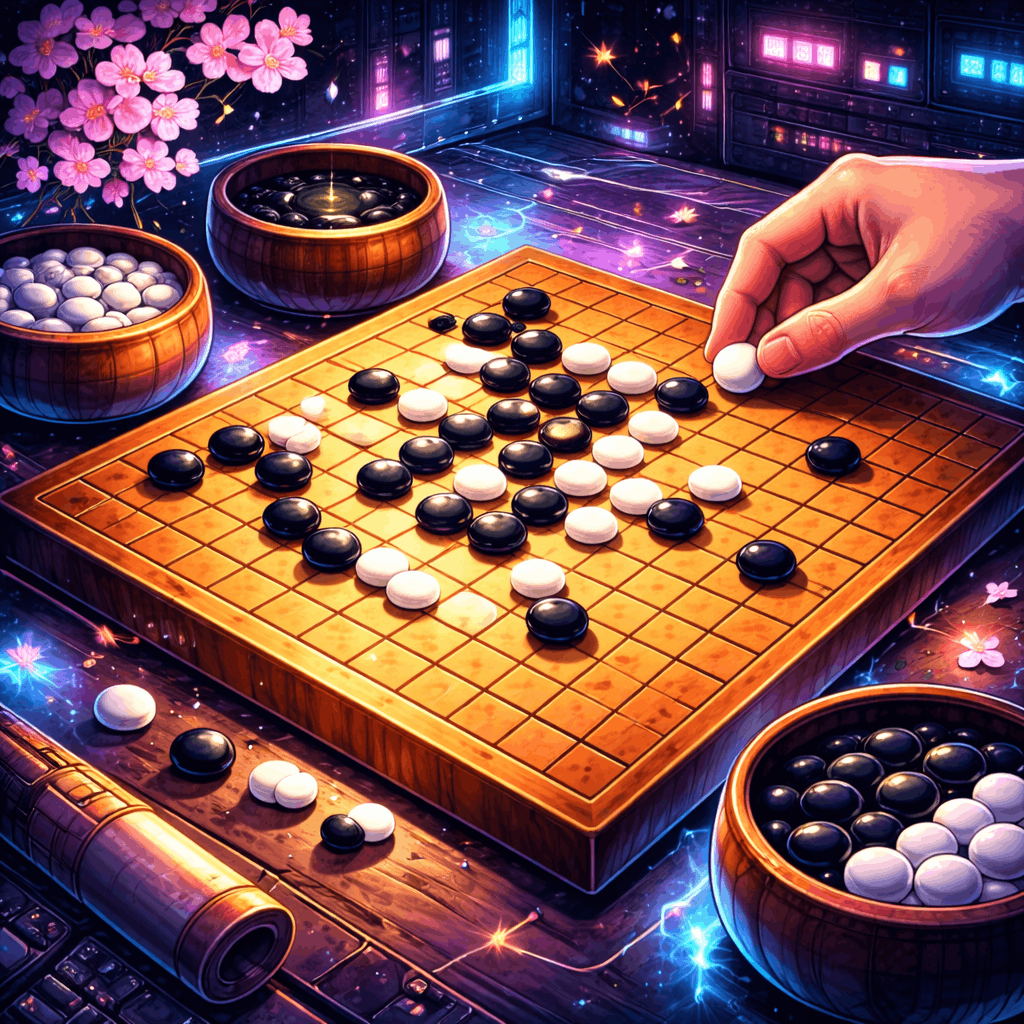
Chess is a 64-square knife fight: armies start face to face, tactics bite from the opening moves, and games funnel toward checkmating one king. Go opens on an empty 19×19 board of 361 points; stones never move once placed, and the goal is surrounding territory, not killing a single target. Multiple battles run simultaneously across the board, and choosing which to fight — whole-board judgement — matters as much as winning any one of them. Chess is a battle; Go is a war of borders.
Why Go resisted computers
Deep Blue beat Garry Kasparov in 1997 using search plus handcrafted evaluation — chess positions can be scored by counting material. Go defeated that approach for two more decades: ~250 legal moves per turn versus chess's ~35, around 2×10^170 legal positions, and no simple way to score a position. It took DeepMind's AlphaGo, built on deep neural networks, to beat Lee Sedol 4–1 in March 2016 — a result many researchers had expected to be a decade further away.
Which is easier to learn — and to master?
Go's rules are simpler: place stones, surround territory, capture by removing liberties — about 10 minutes, versus 30–60 for chess's six piece types and special moves. Mastery inverts this: Go's ranking ladder (30 kyu up to 9 dan) is longer, and its handicap-stone system means players of very different strengths still get real games — something chess cannot offer without material odds. If you want competition fast, chess's enormous online pool is unmatched; if you want a lifetime landscape, choose Go.
Pick Go / Weiqi if…
- you want the deepest strategic ceiling in gaming
- you prefer intuition and whole-board judgement to sharp tactics
- you like that handicaps make mismatched games fair
- you are patient with a long, disorienting learning phase
Pick Chess if…
- you want a massive player pool and instant online games
- you enjoy sharp tactics and concrete calculation
- you want abundant beginner content — puzzles, courses, streams
- you prefer games that resolve into a single decisive target
FAQ
Is Go harder than chess?
Harder to master, easier to start. Go's rules take 10 minutes against chess's 30–60, but its search space (~10^170 legal positions versus ~10^45) and whole-board strategy make top-level Go arguably the deeper challenge — AI needed 19 more years to conquer it.
Is Go older than chess?
Yes, by more than a millennium. Go has been played in China for at least 2,500 years, while chess descends from chaturanga, which appeared in India around the 6th century AD.
Why did AI take so much longer to beat Go?
Branching and evaluation. Go offers ~250 legal moves per turn to chess's ~35, and there is no material count to score positions with. Brute-force search failed; it took AlphaGo's neural networks to win in 2016, 19 years after Deep Blue beat Kasparov.
Does chess skill transfer to Go?
Partially. Reading sequences, fighting spirit and competitive discipline carry over, and chess players often excel at Go's local tactics. Whole-board strategy — direction of play, thickness, sacrifice for influence — must be learned from scratch.
How long does a game of Go take?
Casual games on a full 19×19 board run 20–90 minutes; beginners often start on 9×9 boards where games take 10–15 minutes. Professional tournament games can last several hours.
Can a beginner play a strong Go player and have fun?
Yes — this is one of Go's best features. Handicap stones (the weaker player pre-places up to 9) genuinely level the game while keeping it instructive for both sides. Chess has no equally graceful equivalent.

MAIN MENU
PvP Games
 Battleship
 Crazy Eights
 Dots & Boxes Blitz
 Gomoku
 Ludo
Ludo Quoridor
 Snakes & Ladders
 Yahtzee
Free Games
 Alquerque
 Backgammon
 Bagh-Chal
 Balut
Balut Battle for TokyoBattleship
 Bingo
Bingo Brick Breaker
 Bridge
 Bunco
Bunco Callbreak
 Checkers
 Chess
Chess ChompCrazy Eights
 Cribbage
 Dara
Dara Derby Dash
 DominoesDots & Boxes Blitz
 Durak
Durak Emberdeep
 Euchre
 Fanorona
 Farkle
 Fox and Geese
 Fox and Hounds
 Generala
 Gin Rummy
 Go / WeiqiGomoku
 Hazard
 Hearts
 Hex
Hex Higher or Lower
 Hnefatafl
 Hounds and Jackals
 Indian Rummy
 Jungle
 Ludus Latrunculorum
 Liar's DiceLudo
 Mahjong Solitaire
 Mancala
 Minesweeper
 Nim
Nim Nine Men's Morris
 Onitama
 Patolli
 Peg Solitaire
 Pentago
 Pente
Pente Pig
Pig PylosQuoridor
 Reversi
 Royal Game of Ur
 Scratch Cards
 Seega
Seega Senet
Senet Shax
Shax Ship, Captain, Crew
 Shut the Box
 Sixteen Soldiers
 SnakeSnakes & Ladders
 Klondike Solitaire
 Space Blaster
 Spades
 Sugar Pop
 Sungka
 Tangram
 Tile Rummy
 Tower
Tower Truco
Truco War
War Word Spy
 XII ScriptaYahtzee
NEED HELP?