Gomoku vs Pente: Five-in-a-Row Games Compared
The Verdict
Play Gomoku if you want the purest five-in-a-row duel — just place stones, no captures, deep forcing sequences. Play Pente if you want more dynamism: flanked pairs are captured, and five captured pairs win outright, so defence can never be passive. Freestyle Gomoku is a proven first-player win (Allis, 1993); Pente's captures keep games less scripted.
Side by Side
| Gomoku | Pente | |
|---|---|---|
| Players | 2 | 2 |
| Board | 15×15 (traditionally a 19×19 Go board) | 19×19 |
| Win condition | 5 in a row | 5 in a row or 5 captured pairs |
| Average game length | 5–15 min | 10–20 min |
| Luck vs skill | 100% skill | 100% skill |
| Rules complexity | ~2 min to learn | ~5 min to learn |
| Solved status | Freestyle solved 1993: first player wins | Unsolved; tournament rules restrict move 2 |
| First appeared | Heian-era Japan (~8th–12th c.), Chinese roots | 1977, Gary Gabrel (USA, from ninuki-renju) |
Same goal, different weapons
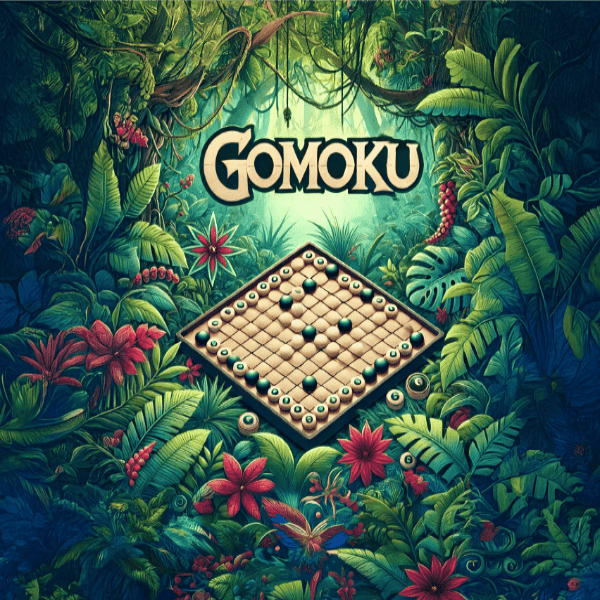
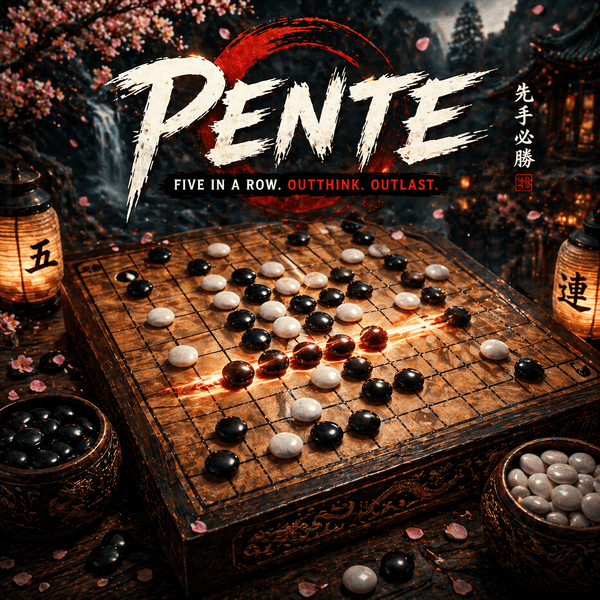
Both games race to place five stones in a row, and both are pure-skill, perfect-information duels. The difference is Pente's capture rule: if your two adjacent stones are flanked at both ends by enemy stones, the pair is removed — and five captured pairs win the game outright. That single rule transforms defence. In Gomoku you can block a threat and forget it; in Pente careless blocking hands your opponent captures, so every defensive stone must also be safe.
Balance and solved status
Freestyle Gomoku is provably unfair: Victor Allis showed in 1993 that the first player wins with perfect play on 15×15, which is why serious play uses Renju's restrictions or swap openings to rebalance it. Pente has a first-player advantage too — tournament rules force the first player's second stone at least three intersections from the centre — but the capture mechanic keeps play far less scripted, and the game has not been solved.
Which is easier to learn?
Gomoku is about the simplest strategy game there is: place a stone, make five in a row, done — 2 minutes to teach. Pente adds only the capture rule, perhaps 5 minutes. Skill transfers almost completely in one direction: strong Gomoku players already read open threes, fours and double threats, which is most of Pente. Going the other way, Pente players must unlearn the reflex of relying on captures to break threats.
Pick Gomoku if…
- you want the fastest possible route into abstract strategy
- you enjoy pure threat-sequence calculation
- you want a game you can play on any Go set or grid paper
- you plan to progress to Renju's tournament rules later
Pick Pente if…
- you find plain five-in-a-row too scripted
- you want a second win condition to play for
- you enjoy tactical captures and counter-attacks
- you want a livelier game for mixed skill levels
FAQ
Is Gomoku a solved game?
Yes. Victor Allis proved in 1993 that freestyle Gomoku on a 15×15 board is a first-player win with perfect play. Competitive play compensates with Renju restrictions or swap-style opening rules.
What is the difference between Gomoku and Pente?
Pente adds captures: a pair of adjacent stones flanked at both ends is removed, and capturing five pairs wins the game. Gomoku has no captures — the only goal is five in a row. Pente is also usually played on a 19×19 board.
Can you win Pente without getting five in a row?
Yes. Capturing five pairs of your opponent's stones — 10 stones in total — wins immediately. Strong players constantly weigh the row threat against the capture count.
Is Pente based on Gomoku?
Indirectly. Gary Gabrel created Pente in 1977 in Oklahoma, basing it on ninuki-renju, a Japanese capture variant of the gomoku family. So the capture idea itself has Japanese roots.
Is Gomoku the same as five in a row?
Yes. Gomoku is the Japanese name for five in a row; it is called omok in Korea and wuziqi in China. Rule sets differ mainly in board size and first-player restrictions.
Which should I learn first?
Gomoku — it teaches the core threat patterns in a 2-minute rule set. Once open threes and fours feel natural, Pente's capture rule adds welcome complexity rather than confusion.

MAIN MENU
PvP Games
 Battleship
 Crazy Eights
 Dots & Boxes Blitz
 Gomoku
 Ludo
Ludo Quoridor
 Snakes & Ladders
 Yahtzee
Free Games
 Alquerque
 Backgammon
 Bagh-Chal
 Balut
Balut Battle for TokyoBattleship
 Bingo
Bingo Brick Breaker
 Bridge
 Bunco
Bunco Callbreak
 Checkers
 Chess
Chess ChompCrazy Eights
 Cribbage
 Dara
Dara Derby Dash
 DominoesDots & Boxes Blitz
 Durak
Durak Emberdeep
 Euchre
 Fanorona
 Farkle
 Fox and Geese
 Fox and Hounds
 Generala
 Gin Rummy
 Go / WeiqiGomoku
 Hazard
 Hearts
 Hex
Hex Higher or Lower
 Hnefatafl
 Hounds and Jackals
 Indian Rummy
 Jungle
 Ludus Latrunculorum
 Liar's DiceLudo
 Mahjong Solitaire
 Mancala
 Minesweeper
 Nim
Nim Nine Men's Morris
 Onitama
 Patolli
 Peg Solitaire
 Pentago
 Pente
Pente Pig
Pig PylosQuoridor
 Reversi
 Royal Game of Ur
 Scratch Cards
 Seega
Seega Senet
Senet Shax
Shax Ship, Captain, Crew
 Shut the Box
 Sixteen Soldiers
 SnakeSnakes & Ladders
 Klondike Solitaire
 Space Blaster
 Spades
 Sugar Pop
 Sungka
 Tangram
 Tile Rummy
 Tower
Tower Truco
Truco War
War Word Spy
 XII ScriptaYahtzee
NEED HELP?