Quoridor vs Hex: Which Abstract Strategy Game Wins?
The Verdict
Play Quoridor if you want a tactile, readable duel — race your pawn across a 9×9 board while spending 10 walls to slow your opponent. Play Hex if you want the deeper, purer abstract: connect your two sides of an 11×11 rhombus, draws are mathematically impossible, and a first-player winning strategy is proven to exist yet nobody knows it.
Side by Side
| Quoridor | Hex | |
|---|---|---|
| Players | 2 or 4 | 2 |
| Board | 9×9 grid + 10 walls each | 11×11 rhombus (up to 19×19) |
| Average game length | 10–20 min | 15–30 min |
| Luck vs skill | 100% skill | 100% skill |
| Rules complexity | ~3 min to learn | ~1 min to learn |
| Draws possible | Effectively no — a path must always remain | No — proven impossible |
| Notable maths | Walls may never seal off every path | Strategy-stealing proof of first-player win |
| First appeared | 1997, Mirko Marchesi (Gigamic) | 1942, Piet Hein; 1948, John Nash independently |
Two ways to fight over space
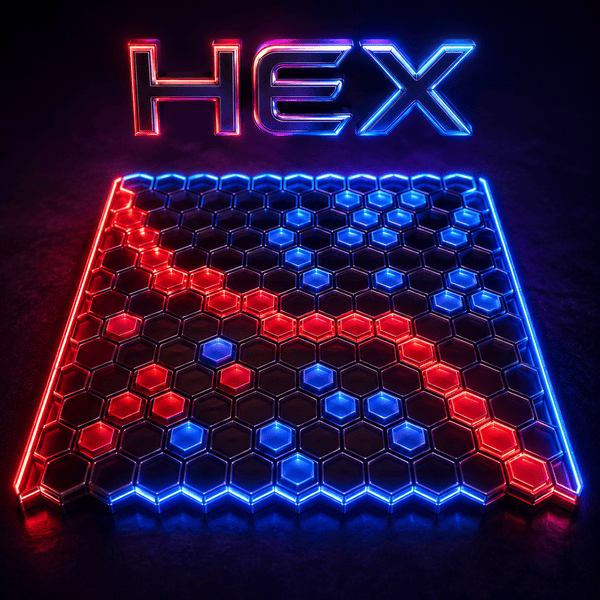
Quoridor is a race with sabotage: move your pawn one square per turn toward the far side, or spend one of your 10 walls to lengthen your opponent's path. The rules forbid sealing a player in completely — a route must always exist — so walls buy time rather than victory. Hex has no pawns and no race: players alternately place stones on an 11×11 rhombus, trying to connect their two opposite edges. One game is about delay; the other about inevitability.
Mathematical pedigree
Hex is a mathematician's game. Piet Hein introduced it in 1942 and John Nash reinvented it at Princeton in 1948, where the strategy-stealing argument proved the first player has a winning strategy — though nobody knows what it is on full-size boards. Draws are impossible: any filled Hex board contains exactly one side's winning connection, a fact equivalent to Brouwer's fixed-point theorem. Quoridor (Mirko Marchesi, 1997) has no such theory but offers crisp, human-scale tactics.
Which is easier to learn?
Both are learnable in minutes, but they diverge in feel. Quoridor is more approachable: you can see the race, count path lengths, and children from about age 6 play it happily; expert play is mostly efficient wall timing. Hex's two rules hide a brutally deep game — bridges, ladders and edge templates take real study, and early central moves have consequences a beginner cannot yet read. Pick Quoridor for family play, Hex for depth per rule.
Pick Quoridor if…
- you want an abstract game the whole family can read at a glance
- you enjoy spatial blocking and route-counting
- you sometimes want a 4-player option
- you like physical, tactile components
Pick Hex if…
- you want maximum depth from minimum rules
- you enjoy games with real mathematical structure
- you never want a draw to be possible
- you are happy to lose 50 games while learning the patterns
FAQ
Can Hex end in a draw?
No. It is mathematically impossible: once the board fills, exactly one player must have a connection between their edges. The proof is closely related to Brouwer's fixed-point theorem.
Who invented Hex?
Piet Hein introduced it in Denmark in 1942, and John Nash independently reinvented it at Princeton in 1948. Nash's strategy-stealing argument also proved the first player has a winning strategy.
Can you completely wall someone in at Quoridor?
No. Every wall placement must leave at least one open path to the goal for every pawn — it is illegal otherwise. Walls delay opponents; they can never trap them permanently.
Is Quoridor a solved game?
No. Smaller Quoridor boards have been analysed by computers, but the standard 9×9 game with 20 walls remains unsolved. Hex is likewise unsolved on full-size boards despite its first-player-win proof.
How many walls do you get in Quoridor?
Ten each in the two-player game, five each with four players. Wall economy — when to spend versus when to run — is the heart of Quoridor strategy.
Is Hex harder than Quoridor?
Harder to master, yes. Both are easy to learn, but Hex's connection strategy — bridges, ladders, edge templates — runs far deeper, and top-level Hex remains beyond full computer analysis on large boards.

MAIN MENU
PvP Games
 Battleship
 Crazy Eights
 Dots & Boxes Blitz
 Gomoku
 Ludo
Ludo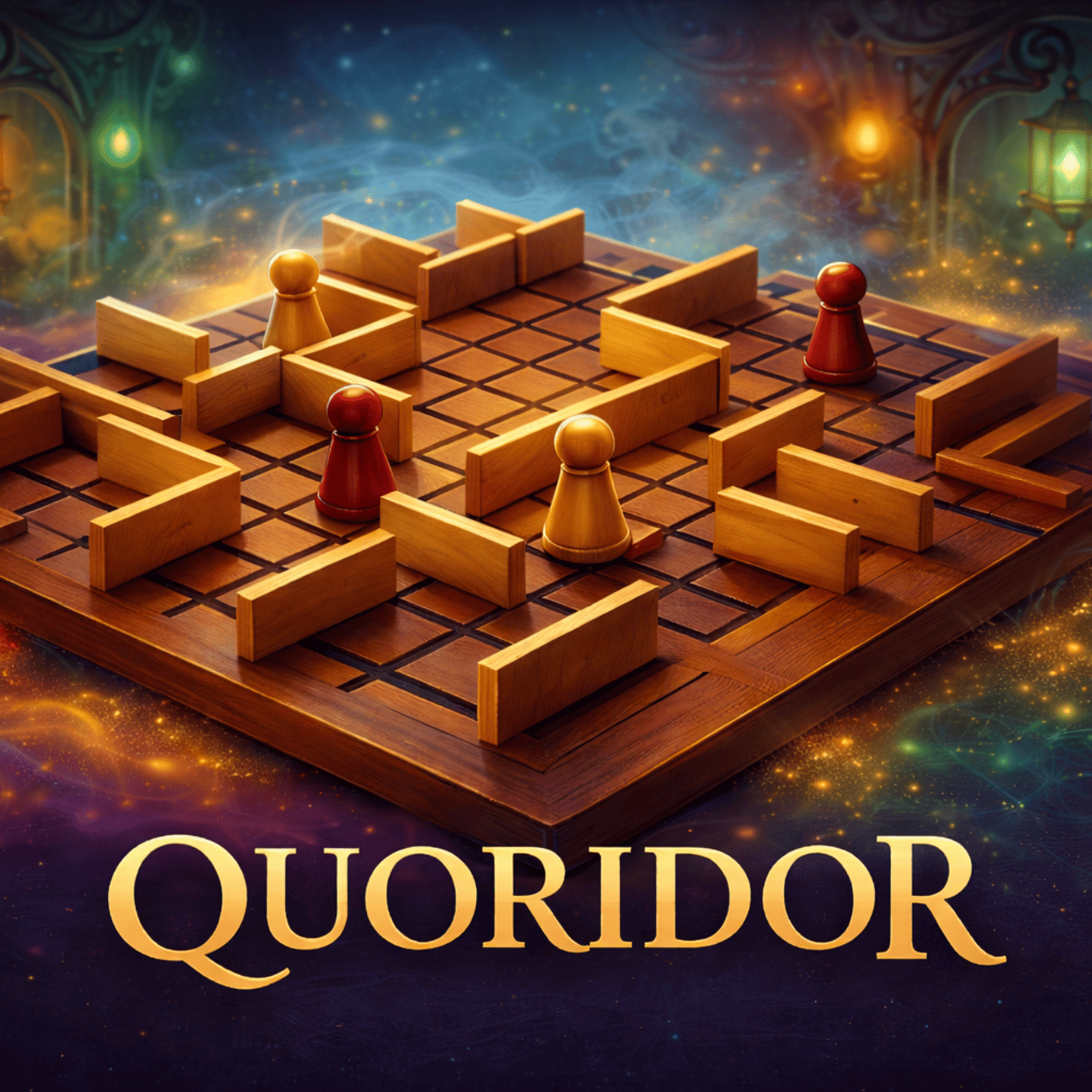 Quoridor
 Snakes & Ladders
 Yahtzee
Free Games
 Alquerque
 Backgammon
 Bagh-Chal
 Balut
Balut Battle for TokyoBattleship
 Bingo
Bingo Brick Breaker
 Bridge
 Bunco
Bunco Callbreak
 Checkers
 Chess
Chess ChompCrazy Eights
 Cribbage
 Dara
Dara Derby Dash
 DominoesDots & Boxes Blitz
 Durak
Durak Emberdeep
 Euchre
 Fanorona
 Farkle
 Fox and Geese
 Fox and Hounds
 Generala
 Gin Rummy
 Go / WeiqiGomoku
 Hazard
 Hearts
 Hex
Hex Higher or Lower
 Hnefatafl
 Hounds and Jackals
 Indian Rummy
 Jungle
 Ludus Latrunculorum
 Liar's DiceLudo
 Mahjong Solitaire
 Mancala
 Minesweeper
 Nim
Nim Nine Men's Morris
 Onitama
 Patolli
 Peg Solitaire
 Pentago
 Pente
Pente Pig
Pig PylosQuoridor
 Reversi
 Royal Game of Ur
 Scratch Cards
 Seega
Seega Senet
Senet Shax
Shax Ship, Captain, Crew
 Shut the Box
 Sixteen Soldiers
 SnakeSnakes & Ladders
 Klondike Solitaire
 Space Blaster
 Spades
 Sugar Pop
 Sungka
 Tangram
 Tile Rummy
 Tower
Tower Truco
Truco War
War Word Spy
 XII ScriptaYahtzee
NEED HELP?