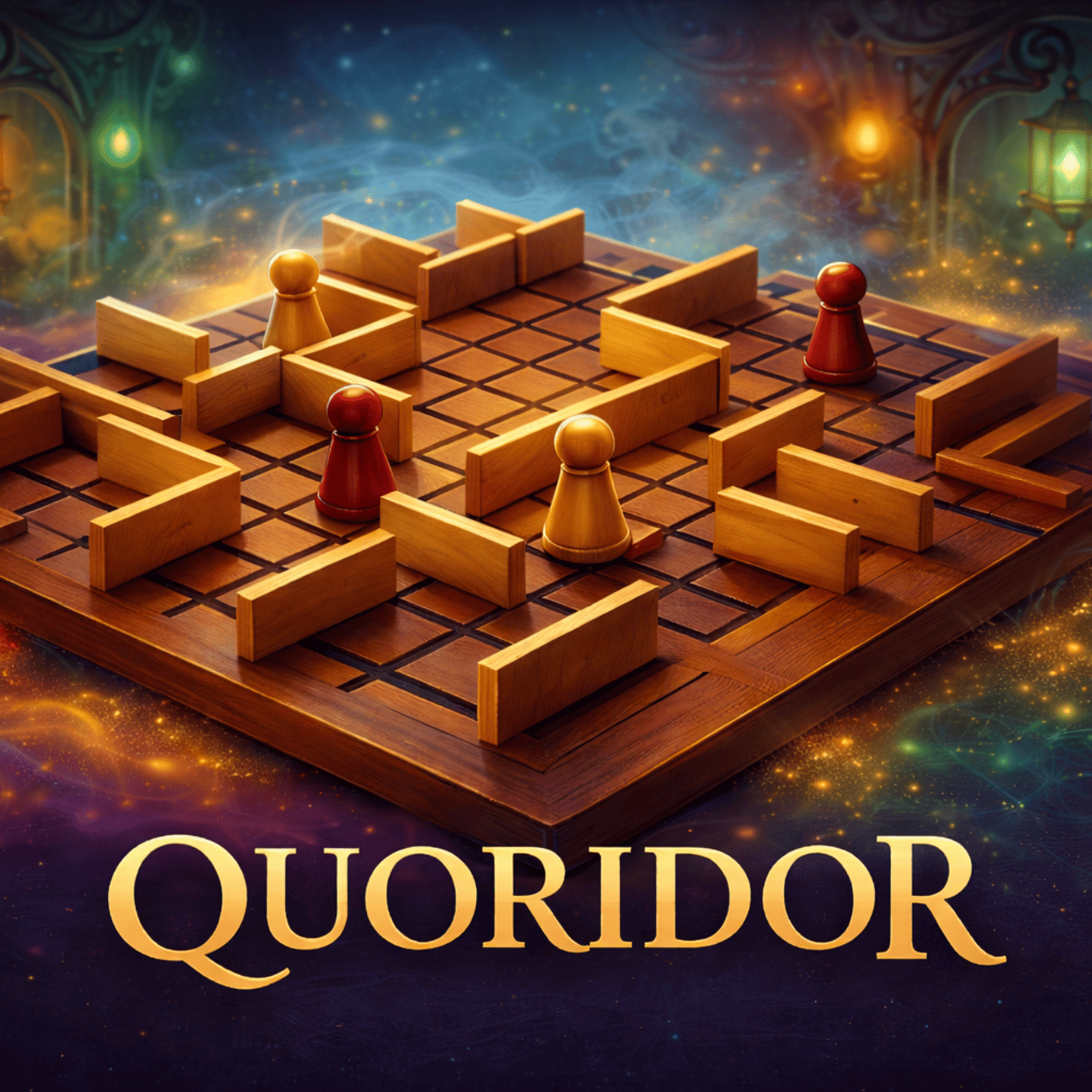
Quoridor - Rules, History & Strategy Guide
Quoridor is a two-player abstract strategy game played on a 9×9 board. Each turn you either move your pawn one square or place one of your ten walls to slow your opponent, and the first pawn to reach the opposite side wins. A typical game lasts 10 to 20 minutes.
Reviewed & updated
History & Origins
Quoridor was created by Mirko Marchesi and published in 1997 by French game company Gigamic. It won the Mensa Select award and multiple other honors for its elegant simplicity.
The game distills abstract strategy into two clean choices each turn: move or wall. That simplicity makes it easy to learn but remarkably deep once you start thinking several moves ahead.
How to Play
The goal is to be the first player to reach the opposite side of the board.
- On your turn, either move your pawn one square orthogonally or place a wall.
- Walls are two squares long and block movement through those squares.
- Each player has 10 walls total for the entire game.
- You cannot place a wall that completely blocks your opponent from reaching their goal row.
- The first player to reach any square on the opposite row wins.
Strategy Tips
Strong Quoridor play combines efficient pathfinding with disruptive wall placement.
- Place early walls near the center where they affect the most possible paths.
- Force your opponent into long detours while keeping your own path short.
- Balance wall use: saving walls for the endgame is powerful, but waiting too long means your opponent races ahead.
- Count shortest paths for both players before deciding whether to move or wall.
Variations
The standard game is 2-player on a 9x9 board. A 4-player variant exists where each player starts from one edge with 5 walls each. Some variants use larger boards or asymmetric wall counts.
Play Quoridor on Arcadia
Play Quoridor on Arcadia to race, block, and outmaneuver an AI opponent one wall at a time.
Quick Answers
How do you win Quoridor?
Be the first player to move your pawn to any square on the opposite side of the board.
Can you completely block your opponent in Quoridor?
No. The rules require that every wall placement must leave at least one path open for both players to reach their goal row.
How many walls do you get in Quoridor?
Each player gets 10 walls in the standard two-player game.
Is Quoridor a game of luck or skill?
Quoridor is pure skill. There are no dice or hidden information — both players see the board, the pawns and every remaining wall, so the result comes down to pathfinding and wall timing. It belongs to the same perfect-information family as chess and Go.
How long does a game of Quoridor take?
A typical game lasts 10 to 20 minutes. Beginners often finish faster because they spend their walls early, while experienced players stretch games out by holding walls back for the endgame race.
Can you jump over your opponent in Quoridor?
Yes. When the two pawns stand face to face, you may jump straight over your opponent to the square directly beyond. If a wall or the board edge blocks that landing square, you may step to one of the diagonal squares beside the opposing pawn instead.
How big is a Quoridor board?
The standard board is 9×9 — 81 squares — with grooves between them where walls slot in. Players share 20 walls, 10 each, and every wall spans two squares. The four-player variant uses the same board with five walls per player.
Who invented Quoridor?
Quoridor was designed by Mirko Marchesi and published by the French company Gigamic in 1997. It won the Mensa Select award and became one of the best-known modern abstracts alongside stablemates such as Quarto and Pylos.
Should you move your pawn or place a wall first in Quoridor?
Most strong players advance the pawn in the opening rather than spending walls early. Walls are a limited resource — you only have ten — so the usual advice is to race until a wall clearly buys you more distance than a step does, then place it where it forces the longest detour.
What happens when you run out of walls in Quoridor?
Once your ten walls are gone, you can only move your pawn for the rest of the game. That turns the endgame into a pure race, which is why wall counting matters: the player with walls in hand controls the final stretch. Spending your last wall carelessly often loses the game.
Can you play Quoridor online for free?
Yes. Arcadia offers free Quoridor in the browser against an AI opponent — no download or account required. It is a convenient way to practise counting shortest paths before facing human opposition.

MAIN MENU
PvP Games
 Battleship
 Crazy Eights
 Dots & Boxes Blitz
 Gomoku
 LudoQuoridor
 Snakes & Ladders
 Yahtzee
Free Games
 Alquerque
 Backgammon
 Bagh-Chal
 Balut
Balut Battle for TokyoBattleship
 Bingo
Bingo Brick Breaker
 Bridge
 Bunco
Bunco Callbreak
 Checkers
 Chess
Chess ChompCrazy Eights
 Cribbage
 Dara
Dara Derby Dash
 DominoesDots & Boxes Blitz
 Durak
Durak Emberdeep
 Euchre
 Fanorona
 Farkle
 Fox and Geese
 Fox and Hounds
 Generala
 Gin Rummy
 Go / WeiqiGomoku
 Hazard
 Hearts
 Hex
Hex Higher or Lower
 Hnefatafl
 Hounds and Jackals
 Indian Rummy
 Jungle
 Ludus Latrunculorum
 Liar's DiceLudo
 Mahjong Solitaire
 Mancala
 Minesweeper
 Nim
Nim Nine Men's Morris
 Onitama
 Patolli
 Peg Solitaire
 Pentago
 Pente
Pente Pig
Pig PylosQuoridor
 Reversi
 Royal Game of Ur
 Scratch Cards
 Seega
Seega Senet
Senet Shax
Shax Ship, Captain, Crew
 Shut the Box
 Sixteen Soldiers
 SnakeSnakes & Ladders
 Klondike Solitaire
 Space Blaster
 Spades
 Sugar Pop
 Sungka
 Tangram
 Tile Rummy
 Tower
Tower Truco
Truco War
War Word Spy
 XII ScriptaYahtzee
NEED HELP?