Reversi (Othello) vs Go: Which Territory Game to Play?
The Verdict
Play Reversi if you want a territory battle that fits in 15 minutes: an 8×8 board, one rule — flank and flip — and wild momentum swings where the disc count means little until the end. Play Go for the grander canvas: 19×19, stones that never move, and a lifetime of depth. Reversi is far quicker to learn and to finish.
Side by Side
| Reversi | Go / Weiqi | |
|---|---|---|
| Players | 2 | 2 |
| Board | 8×8, 64 discs | 19×19, 361 points |
| Average game length | 10–20 min | 20–90 min |
| Luck vs skill | 100% skill | 100% skill |
| Rules complexity | ~2 min to learn | ~10 min to learn |
| Core mechanic | Flip flanked discs | Surround territory; capture by removing liberties |
| Solved status | 8×8 Othello weakly solved 2023: a draw | Unsolved; ~2×10^170 legal positions |
| First appeared | 1883 England; Othello rules 1971, Japan | China, ~2,500+ yrs ago |
Opposite theories of territory
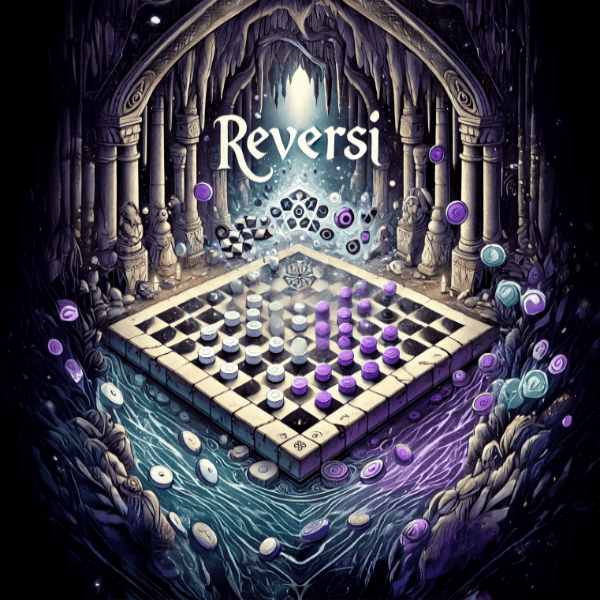
Both games end by counting who controls more of the board, but they get there in opposite ways. In Go, stones are permanent: territory is built from walls that, once alive, never move, so the game is about efficient investment. In Reversi, nothing is safe until it is anchored: every disc caught between two enemy discs flips, so owning the middle of the board is an illusion. Only corners and stable edges are permanent — which is why strong Reversi play often means deliberately keeping your disc count low until the endgame.
Depth, length and solvability
Reversi is compact: 8×8, at most 60 moves, 10–20 minutes per game — and shallow enough for computers that a 2023 computational study weakly solved Othello, showing perfect play by both sides ends in a 32–32 draw. Go sits at the other extreme: ~2×10^170 legal positions, games of 150–300 moves, and no prospect of ever being solved. That does not make Reversi trivial for humans — top-level play is deeply counterintuitive — but the ceilings differ by orders of magnitude.
Which should you learn?
Learn Reversi when you want an elegant territory game that fits into a lunch break and teaches in 2 minutes — its mobility-versus-greed lesson (take fewer discs early, keep options open) is a beautiful strategic idea on its own. Learn Go when you are ready to commit: the first 50 games are disorienting, but concepts like influence, thickness and sente reward study like nothing else in gaming. Reversi first is a reasonable on-ramp for the territory-counting mindset.
Pick Reversi if…
- you want complete games inside 20 minutes
- you enjoy dramatic momentum swings and comebacks
- you want a 2-minute rule set with real strategic bite
- you like endgames that come down to exact counting
Pick Go / Weiqi if…
- you want a game you can study for the rest of your life
- you prefer gradual territorial construction to sudden reversals
- you value the handicap system for mixed-strength play
- you are drawn to Go's 2,500-year competitive tradition
FAQ
Are Reversi and Othello the same game?
Nearly. Reversi appeared in England in 1883 with a free opening; Othello, trademarked in Japan in 1971 by Goro Hasegawa, fixed the four starting discs in the centre. Modern play almost universally uses the Othello setup.
Has Othello been solved?
Effectively, yes. A 2023 computational study weakly solved 8×8 Othello, concluding that perfect play by both sides ends in a 32–32 draw. Go, by contrast, is nowhere near being solved.
Is Reversi good preparation for Go?
Somewhat. It builds the habit of thinking in territory and endgame counting, and its mobility concept loosely parallels Go's efficiency ideas. But stones flipping versus stones being permanent makes the core intuitions quite different.
Why do Othello games swing so wildly?
Because discs keep changing sides. A large mid-game disc lead often signals weakness — more discs mean fewer legal moves later. The evaluation that matters is mobility and corner access, and those can invert the position in two moves.
Which is harder, Reversi or Go?
Go, by a wide margin at the top: its board is 5.6 times bigger by points, its game tree astronomically larger, and its professional tradition runs 2,500+ years. Reversi is the harder game to evaluate intuitively per minute of rules, though — beginners routinely misjudge who is winning.

MAIN MENU
PvP Games
 Battleship
 Crazy Eights
 Dots & Boxes Blitz
 Gomoku
 Ludo
Ludo Quoridor
 Snakes & Ladders
 Yahtzee
Free Games
 Alquerque
 Backgammon
 Bagh-Chal
 Balut
Balut Battle for TokyoBattleship
 Bingo
Bingo Brick Breaker
 Bridge
 Bunco
Bunco Callbreak
 Checkers
 Chess
Chess ChompCrazy Eights
 Cribbage
 Dara
Dara Derby Dash
 DominoesDots & Boxes Blitz
 Durak
Durak Emberdeep
 Euchre
 Fanorona
 Farkle
 Fox and Geese
 Fox and Hounds
 Generala
 Gin Rummy
 Go / WeiqiGomoku
 Hazard
 Hearts
 Hex
Hex Higher or Lower
 Hnefatafl
 Hounds and Jackals
 Indian Rummy
 Jungle
 Ludus Latrunculorum
 Liar's DiceLudo
 Mahjong Solitaire
 Mancala
 Minesweeper
 Nim
Nim Nine Men's Morris
 Onitama
 Patolli
 Peg Solitaire
 Pentago
 Pente
Pente Pig
Pig PylosQuoridor
 Reversi
 Royal Game of Ur
 Scratch Cards
 Seega
Seega Senet
Senet Shax
Shax Ship, Captain, Crew
 Shut the Box
 Sixteen Soldiers
 SnakeSnakes & Ladders
 Klondike Solitaire
 Space Blaster
 Spades
 Sugar Pop
 Sungka
 Tangram
 Tile Rummy
 Tower
Tower Truco
Truco War
War Word Spy
 XII ScriptaYahtzee
NEED HELP?