Senet vs Royal Game of Ur: Oldest Board Games Compared
The Verdict
Play the Royal Game of Ur if you want the more trustworthy ancient experience: a Babylonian rules tablet, interpreted by Irving Finkel, means its reconstruction stands on real evidence. Play senet for the older, more atmospheric game — Egyptian boards date to ~3100 BC — accepting that its rules are modern scholarly guesswork. Both are fast, dice-driven race games.
Side by Side
| Senet | Royal Game of Ur | |
|---|---|---|
| Players | 2 | 2 |
| Board | 30 squares (3×10) | 20 squares |
| Pieces | 5–7 per player (reconstructions vary) | 7 per player |
| Randomiser | 4 throwing sticks | 4 tetrahedral (binary) dice |
| Average game length | 15–30 min | 15–20 min |
| Rules evidence | Lost; modern reconstructions (e.g. Kendall) | Partly preserved on a 177 BC cuneiform tablet |
| Luck vs skill | Dice luck + racing tactics | Dice luck + racing tactics |
| First appeared | Egypt, ~3100 BC | Mesopotamia, ~2600 BC |
What the evidence supports
The Royal Game of Ur is the best-documented ancient game we have: boards from ~2600 BC excavated by Leonard Woolley in the 1920s, plus a Babylonian cuneiform tablet from 177 BC describing play, interpreted by the British Museum's Irving Finkel. Senet is older — boards appear in Egypt by ~3100 BC and stayed popular for 3,000 years — but no rulebook survives. Every modern senet set uses a scholarly reconstruction, most famously Timothy Kendall's.
How they play
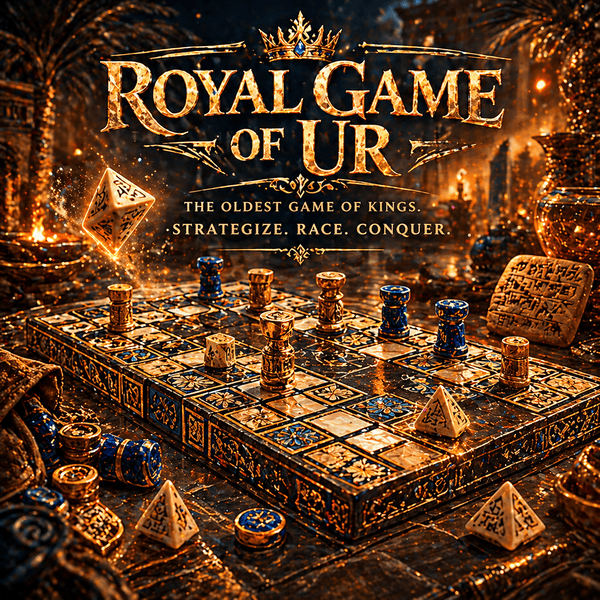
Both are race games with randomisers older than cubic dice. In Ur, two players race seven pieces along a 20-square track shared in the middle, rolling four tetrahedral dice; rosette squares grant extra turns and safety, so play is fast, aggressive and full of hits. Reconstructed senet races five to seven pieces along a 30-square S-shaped path using throwing sticks, with hazard squares near the end — including a 'house of water' that sends a piece back.
Which should you try first?
Start with the Royal Game of Ur. Its rules rest on real evidence, games finish in 15–20 minutes, and the rosette rhythm makes it immediately fun — it plays like a sharper, older ludo. Come to senet when the history itself is the draw: by Egypt's New Kingdom the game had acquired religious weight as a symbolic passage through the afterlife, and boards were placed in tombs, including Tutankhamun's.
Pick Senet if…
- you want the oldest playable game in human history
- you are drawn to Egyptology and afterlife symbolism
- you do not mind rules that are scholarly reconstruction
- you enjoy longer, more deliberate race games
Pick Royal Game of Ur if…
- you want rules backed by an actual ancient document
- you want fast, aggressive 15–20 minute games
- you like the extra-turn rhythm of rosette squares
- you are introducing someone to ancient games for the first time
FAQ
Which is older, senet or the Royal Game of Ur?
Senet, by roughly 500 years. Senet boards appear in Egypt around 3100 BC, while the earliest Royal Game of Ur boards date to ~2600 BC from the Royal Cemetery at Ur in Mesopotamia.
Do we know senet's real rules?
No. Despite thousands of surviving boards and tomb paintings of people playing, no Egyptian rules text has ever been found. Modern rules, such as Timothy Kendall's reconstruction, are informed scholarly guesses.
How were the Royal Game of Ur's rules recovered?
From a Babylonian cuneiform tablet written in 177 BC, interpreted by British Museum curator Irving Finkel. It describes play on the 20-square board more than 2,000 years after the game first appeared, so the early rules may have differed.
Was senet a religious game?
It became one. Senet began as entertainment, but by Egypt's New Kingdom (~1550 BC onward) it symbolised the soul's journey through the afterlife, appears in the Book of the Dead, and boards were buried in tombs — Tutankhamun's included.
Is the Royal Game of Ur an ancestor of backgammon?
It is an early member of the same race-game tradition, and many historians treat it as a distant relative of the tables family that produced backgammon. A direct line of descent cannot be proven, but the racing-with-dice DNA is clearly shared.
How long do these games take to play?
Both are quick: the Royal Game of Ur typically runs 15–20 minutes, and reconstructed senet 15–30 minutes. Both make good repeated-play games rather than single long sessions.

MAIN MENU
PvP Games
 Battleship
 Crazy Eights
 Dots & Boxes Blitz
 Gomoku
 Ludo
Ludo Quoridor
 Snakes & Ladders
 Yahtzee
Free Games
 Alquerque
 Backgammon
 Bagh-Chal
 Balut
Balut Battle for TokyoBattleship
 Bingo
Bingo Brick Breaker
 Bridge
 Bunco
Bunco Callbreak
 Checkers
 Chess
Chess ChompCrazy Eights
 Cribbage
 Dara
Dara Derby Dash
 DominoesDots & Boxes Blitz
 Durak
Durak Emberdeep
 Euchre
 Fanorona
 Farkle
 Fox and Geese
 Fox and Hounds
 Generala
 Gin Rummy
 Go / WeiqiGomoku
 Hazard
 Hearts
 Hex
Hex Higher or Lower
 Hnefatafl
 Hounds and Jackals
 Indian Rummy
 Jungle
 Ludus Latrunculorum
 Liar's DiceLudo
 Mahjong Solitaire
 Mancala
 Minesweeper
 Nim
Nim Nine Men's Morris
 Onitama
 Patolli
 Peg Solitaire
 Pentago
 Pente
Pente Pig
Pig PylosQuoridor
 Reversi
 Royal Game of Ur
 Scratch Cards
 Seega
Seega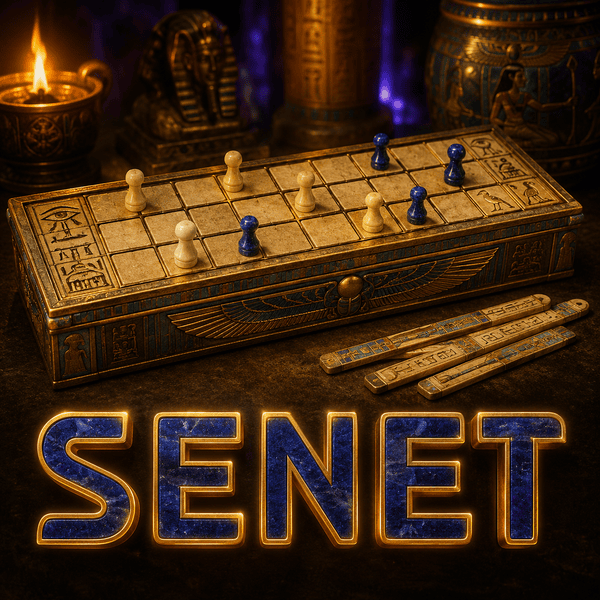 Senet
Senet Shax
Shax Ship, Captain, Crew
 Shut the Box
 Sixteen Soldiers
 SnakeSnakes & Ladders
 Klondike Solitaire
 Space Blaster
 Spades
 Sugar Pop
 Sungka
 Tangram
 Tile Rummy
 Tower
Tower Truco
Truco War
War Word Spy
 XII ScriptaYahtzee
NEED HELP?