Seega vs Latrunculi: Ancient Capture Games Compared
The Verdict
Play Latrunculi for the better-attested ancient game: Roman writers mention it from the 1st century BC, and with no safe squares every advance risks a flanking capture. Play Seega for its two-phase rhythm — both players drop all their pieces before anyone moves, and the centre square is permanent safe ground. Both capture the same way: sandwich an enemy piece between two of yours.
Side by Side
| Seega | Ludus Latrunculorum | |
|---|---|---|
| Players | 2 | 2 |
| Board | 5×5 (also 7×7 and 9×9) | Varies; commonly 8×8 up to 8×12 |
| Pieces | 12 per player (5×5 board) | Reconstructions vary with board size |
| Phases | Two: drop all pieces, then move | One: movement from the start |
| Safe squares | Centre square is safe | None |
| Capture | Custodian (flank on two opposite sides) | Custodian (flank on two opposite sides) |
| Rules certainty | Recorded from 19th-century Egypt; variants differ | Reconstructed; no Roman rulebook survives |
| First appeared | Attested 19th c. Egypt/Sudan; older roots uncertain | Rome, attested ~1st c. BC (Varro) |
One capture rule, two systems
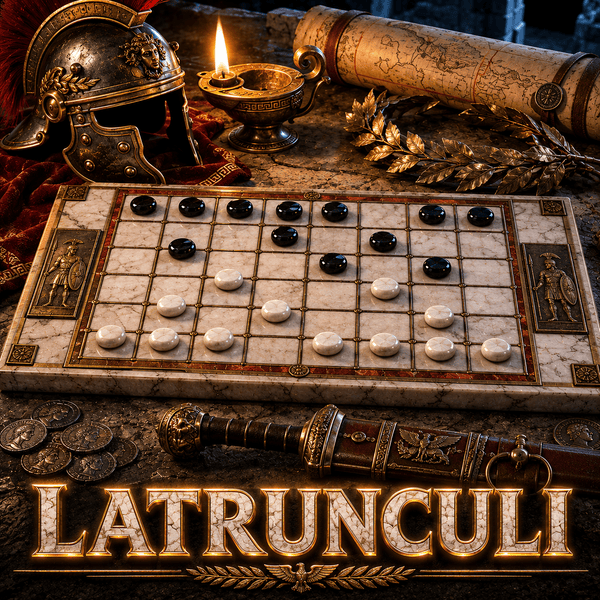
Both games kill the same way: custodian capture, sandwiching an enemy piece between two of yours along a rank or file — and in both, moving voluntarily into a sandwich is safe. Around that shared rule they diverge completely. Seega opens with a placement phase: players alternately drop two pieces at a time onto the 5×5 board until only the centre stands empty, so the whole position is built before a single piece moves. Latrunculi is pure movement — pieces manoeuvre one square at a time from the start, and the game is feint, blockade and the slow construction of traps.
What the evidence actually shows
Latrunculi is attested where it matters: Varro names it in the 1st century BC, Ovid advises his readers to play it well, and the Laus Pisonis praises a nobleman's play in some detail, while boards survive at Roman sites from Britain to Egypt. Even so, no rulebook survives — modern rules are scholarly reconstruction. Seega's dating deserves equal honesty: it is firmly attested only in the modern era, described by Edward Lane in 1830s Egypt and long played in Egypt and Sudan. It is often romantically projected back to pharaonic times, but that ancient link is unproven; its deeper roots are simply uncertain.
Which should you play?
Seega front-loads its strategy: the drop phase is the game's opening book, a poor placement can lose before anything moves, and afterwards the safe centre square becomes a fortress to seize and contest. Latrunculi offers no refuge — with no safe squares, every advanced piece is a potential victim, and games become patient sieges of blockade and immobilisation, fitting for the 'game of little soldiers' that legionaries carried across the empire. Pick Seega for sharp openings and quick games on a scratched grid; pick Latrunculi for the longer positional war.
Pick Seega if…
- you enjoy a placement phase that doubles as an opening book
- you want a safe centre square to fight over
- you like quick games playable on a scratched 5×5 grid
- you are drawn to Egyptian and Sudanese traditional games
Pick Ludus Latrunculorum if…
- you want the game Roman soldiers actually played
- you prefer pure manoeuvre with no placement phase
- you like tense positions where no square is ever safe
- you enjoy blockade and immobilisation strategies
FAQ
What is custodian capture?
Removing an enemy piece by flanking it on two opposite sides with your own pieces — sandwiching rather than jumping or landing on it. It defines Seega, Latrunculi and the Viking tafl games alike, and in all of them a piece that moves between two enemies of its own accord is not captured.
How old is Seega really?
Honestly, we only know it from the modern era. The traveller Edward Lane documented Seega in Egypt in the 1830s, and it has long been played in Egypt and Sudan. Popular accounts call it ancient Egyptian, but no ancient source or securely dated board proves that; its earlier history is simply uncertain.
Did Roman soldiers really play Latrunculi?
Yes — the evidence is unusually good for an ancient game. Varro mentions it in the 1st century BC, Ovid and the Laus Pisonis discuss skilled play, and gaming boards have been excavated at Roman military sites across the empire, from British forts to eastern garrisons.
Do we know Latrunculi's real rules?
No. Roman writers describe the game's flavour — soldiers, ambushes, blockades — but never its full rules, so modern versions are reconstructions built from texts, surviving boards and comparison with related games. The custodian capture is secure; details such as piece counts and win conditions vary by reconstruction.
How does Seega's placement phase work?
Players alternate placing two pieces per turn on any empty squares except the centre, until all 24 pieces are down and only the centre square remains open. No captures happen during placement — but the shapes you build decide the middlegame, so placement is where Seega is largely won or lost.
Are Seega and Latrunculi related?
They are plausibly cousins rather than parent and child. Both belong to the wider custodian-capture family that also includes Greek petteia and Viking hnefatafl, but no direct line of descent between them can be demonstrated from the surviving evidence.

MAIN MENU
PvP Games
 Battleship
 Crazy Eights
 Dots & Boxes Blitz
 Gomoku
 Ludo
Ludo Quoridor
 Snakes & Ladders
 Yahtzee
Free Games
 Alquerque
 Backgammon
 Bagh-Chal
 Balut
Balut Battle for TokyoBattleship
 Bingo
Bingo Brick Breaker
 Bridge
 Bunco
Bunco Callbreak
 Checkers
 Chess
Chess ChompCrazy Eights
 Cribbage
 Dara
Dara Derby Dash
 DominoesDots & Boxes Blitz
 Durak
Durak Emberdeep
 Euchre
 Fanorona
 Farkle
 Fox and Geese
 Fox and Hounds
 Generala
 Gin Rummy
 Go / WeiqiGomoku
 Hazard
 Hearts
 Hex
Hex Higher or Lower
 Hnefatafl
 Hounds and Jackals
 Indian Rummy
 Jungle
 Ludus Latrunculorum
 Liar's DiceLudo
 Mahjong Solitaire
 Mancala
 Minesweeper
 Nim
Nim Nine Men's Morris
 Onitama
 Patolli
 Peg Solitaire
 Pentago
 Pente
Pente Pig
Pig PylosQuoridor
 Reversi
 Royal Game of Ur
 Scratch Cards
 Seega
Seega Senet
Senet Shax
Shax Ship, Captain, Crew
 Shut the Box
 Sixteen Soldiers
 SnakeSnakes & Ladders
 Klondike Solitaire
 Space Blaster
 Spades
 Sugar Pop
 Sungka
 Tangram
 Tile Rummy
 Tower
Tower Truco
Truco War
War Word Spy
 XII ScriptaYahtzee
NEED HELP?