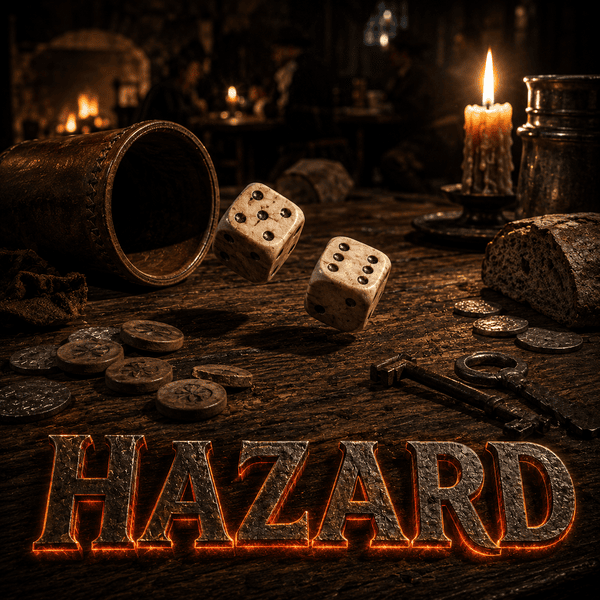
Hazard - Rules, History & Strategy Guide
Hazard is a medieval English dice game and the direct ancestor of craps. The caster names a main from 5 to 9, throws two dice, and either wins instantly with a nick, loses with an out, or rolls on to chase a chance. Each round takes under a minute, and any number can bet.
Reviewed & updated
History & Origins
Hazard is one of the oldest dice games with surviving rules, already notorious when Chaucer’s Pardoner preached against it in the Canterbury Tales in the late 1300s. The name likely travelled from Arabic az-zahr (the die) through Old French into English, and with it came a whole vocabulary: to nick a throw, to be thrown out, and hazard itself as a word for danger, all coined at this table. By the Regency era the game ruled London’s clubs, and Crockford’s famously built a fortune on its odds.
The game crossed the Atlantic through French Louisiana, where players simplified it: fix the main at 7, keep the come-out logic, rename the outs after the local slang for a losing throw, crabs. The result was craps. Every craps player who has rolled a come-out 7, set a point, or crapped out on 2 or 3 is playing recognizable, renamed Hazard.
How to Play
Hazard is a caster-versus-table dice game: you name a target, throw two dice, and either win instantly, lose instantly, or lock into a chase between two numbers.
- Choose a stake, then name your main: any number from 5 to 9.
- Cast two dice. Throwing the main is a nick: an instant even-money win.
- Throwing 2 or 3 is out: an instant loss. 11 and 12 are also out unless they nick your main (11 nicks a main of 7; 12 nicks a main of 6 or 8).
- Any other total becomes your chance: keep casting until either the chance repeats (you win) or the main appears (you lose).
- Settle the round, adjust your stake, and cast again.
Strategy Tips
- Name 7 when you want the most instant wins: it nicks on 7 and 11, eight of the 36 combinations, the best come-out of any main.
- Treat 6 and 8 as the balanced mains: fewer natural nicks, but 12 works for you instead of against you.
- Know the chance-phase odds: mid chances (6, 7, 8) repeat most often, edge chances (4, 10) rarely, so the drama is decided the moment the chance is set.
- Size stakes to survive variance: a cold table eats big bettors first, and Hazard’s streaks were legendary enough to bankrupt Regency lords.
- Play the free-chip version like the sharps played the real one: set a stop-win and stop-loss before the first cast.
Variations
The great variant is craps itself: main fixed at 7, casino betting layers added, and the caster’s even-money duel replaced by pass-line odds. Historical English play also knew grand hazard and chuck-a-luck, three-dice banking games that borrowed the name, and French hasard tables with their own out numbers. Arcadia plays the classical English two-dice rules with mains 5 through 9.
Play Hazard on Arcadia
Play Hazard on Arcadia to cast like a Canterbury pilgrim, nick your main, and see exactly where craps was born.
Quick Answers
How did Hazard turn into craps?
Players in French New Orleans fixed the main at 7 permanently, which turned nicks into naturals (7 and 11) and the fixed outs (2, 3, 12) into craps numbers. The chance became the point, and the modern game was born.
What do nick and out mean?
A nick is an instant winning throw on the come-out: the main itself, plus 11 with a main of 7, or 12 with a main of 6 or 8. An out is an instant loss: 2 or 3 always, and 11 or 12 when they do not nick.
Which main should I pick?
Seven gives the most instant wins (nicks on 7 and 11). Six and eight add 12 as a nick. Five and nine give the fewest nicks and the longest chance chases. All pay even money, so 7 is the sharp’s choice.
Is Hazard played for real money on Arcadia?
No. Arcadia’s Hazard table uses free chips with a refillable bank of 100. The rules, odds, and history are authentic; the wagering is purely for fun.
Can I play Hazard online for free?
Yes. Arcadia offers free Hazard in your browser, with the classical mains, nicks, outs, and chances — no download or account required.
What are the odds of winning at Hazard?
With a main of 7 the caster wins 244 rounds in 495 — about 49.3%, exactly the pass-line probability in modern craps, which copied this structure. The come-out is generous (8 of the 36 dice combinations nick immediately), but the chance phase claws it back, leaving the caster just under even money.
Where does the word hazard come from?
Most etymologies trace it to the Arabic az-zahr, meaning the die, which travelled through Spanish azar and Old French hasard into English as the name of this game. The game was so notorious that the word drifted into meaning peril in general — every “hazard” in modern English started at this dice table.
Did Chaucer really write about Hazard?
Yes. In the Pardoner’s Tale from the Canterbury Tales, written in the late 1300s, the three young rioters are dice players and the Pardoner condemns hazardry at length, calling hazard the very mother of lies. It is one of the earliest literary records of the game.
What was Crockford’s club?
Crockford’s was the gaming club William Crockford, a former fishmonger, opened on St James’s Street in London in 1828. Its hazard bank made him reputedly one of the richest commoners in England while relieving a generation of aristocrats of their fortunes — the classic demonstration that the table’s small edge wins in the long run.
Who is the Groom-Porter in Arcadia’s Hazard?
The Groom-Porter was a real office of the English royal household, responsible from Tudor times for regulating dice, cards and gaming tables at court. Arcadia names its AI banker after the office: you play the caster, and the Groom-Porter runs the table.
Is Hazard a game of skill or luck?
Once the dice leave your hand it is pure chance — no throw can be influenced. The skill sits in the two decisions you do control: which main to name (7 gives the most instant wins, nicking on 8 of 36 combinations) and how to size your stakes so a cold streak cannot wipe you out.
What is grand hazard?
Grand hazard is a three-dice banking game that borrowed the famous name but not the rules — players bet on the outcome of three dice tipped down a chute or cage, as in chuck-a-luck. Classic hazard, the game Arcadia plays, is the two-dice caster’s game with mains, nicks, outs and chances.
How long does a game of Hazard take?
A single round resolves in well under a minute — often on the first cast — and a session lasts as long as your chips do. On Arcadia the bank is 100 free chips, refillable at any time and never real money, so you can play the medieval rules for as long as you like in your browser.
Related Games On Arcadia
Related Guides

MAIN MENU
PvP Games
 Battleship
 Crazy Eights
 Dots & Boxes Blitz
 Gomoku
 Ludo
Ludo Quoridor
 Snakes & Ladders
 Yahtzee
Free Games
 Alquerque
 Backgammon
 Bagh-Chal
 Balut
Balut Battle for TokyoBattleship
 Bingo
Bingo Brick Breaker
 Bridge
 Bunco
Bunco Callbreak
 Checkers
 Chess
Chess ChompCrazy Eights
 Cribbage
 Dara
Dara Derby Dash
 DominoesDots & Boxes Blitz
 Durak
Durak Emberdeep
 Euchre
 Fanorona
 Farkle
 Fox and Geese
 Fox and Hounds
 Generala
 Gin Rummy
 Go / WeiqiGomokuHazard
 Hearts
 Hex
Hex Higher or Lower
 Hnefatafl
 Hounds and Jackals
 Indian Rummy
 Jungle
 Ludus Latrunculorum
 Liar's DiceLudo
 Mahjong Solitaire
 Mancala
 Minesweeper
 Nim
Nim Nine Men's Morris
 Onitama
 Patolli
 Peg Solitaire
 Pentago
 Pente
Pente Pig
Pig PylosQuoridor
 Reversi
 Royal Game of Ur
 Scratch Cards
 Seega
Seega Senet
Senet Shax
Shax Ship, Captain, Crew
 Shut the Box
 Sixteen Soldiers
 SnakeSnakes & Ladders
 Klondike Solitaire
 Space Blaster
 Spades
 Sugar Pop
 Sungka
 Tangram
 Tile Rummy
 Tower
Tower Truco
Truco War
War Word Spy
 XII ScriptaYahtzee
NEED HELP?