Dominoes vs Tile Rummy: Pip Matching or Set Building?
The Verdict
Both are hand-emptying tile races, but they reward different instincts. Dominoes is about restriction: two open ends, and every play narrows what comes next — control them and your opponent suffocates. Tile rummy is about expansion: meld runs and groups, then rearrange the whole table to squeeze out one more play. Pick dominoes for tight, tactical blocking; pick tile rummy for the joy of restructuring a table full of melds.
Side by Side
| Dominoes | Tile Rummy | |
|---|---|---|
| Players | 2 (vs AI here) | 2–4 (vs AI here) |
| Tiles | 28 (double-six set) | 106 (two sets 1–13 + jokers) |
| Average game length | ~10 min per round | 15–25 min |
| Core mechanic | Match pips on two open ends | Meld sets, then rearrange the table |
| Luck vs skill | Draw luck; end-control matters | Draw luck; table vision matters more |
| Rules complexity | ~2 min to learn | ~5 min to learn |
| Decision space | Small but sharp | Grows with every meld on the table |
| Origins | China, via 18th-c. Italy to Europe | Rummikub lineage, 1930s–40s |
Two ends versus a whole table
A dominoes board only ever offers two playable ends, so every decision is a knife-fight over scarce options: which end to feed, which pips to hoard, when to force a pass. Tile rummy runs the other way — once melds hit the table, they become shared raw material, and the best moves split and reassemble existing runs and groups to make room for tiles nobody thought were playable.
Blocking brains versus rebuilding brains
Dominoes rewards inference about hidden information: count what has been played, deduce what your opponent holds, and close the board around it. Tile rummy is nearly all visible — the challenge is combinatorial, seeing that breaking a run of three into two groups unlocks a chain of four further plays. If you like deduction, play dominoes; if you like rearrangement puzzles under a timer, tile rummy is the deeper well.
Which fits your table?
Dominoes is the faster, leaner game — ideal for a quick head-to-head round with instant rematches. Tile rummy suits a longer session and scales to four players, with that signature mid-game moment where the whole table gets rebuilt in one turn. Many players keep both in rotation: dominoes for the coffee break, tile rummy for the evening.
Pick Dominoes if…
- you want rounds done in ten minutes
- you enjoy blocking and deduction
- you prefer a small, sharp decision space
- you like classic pip-and-bones table feel
Pick Tile Rummy if…
- you enjoy rearranging melds to unlock plays
- you want a bigger combinatorial puzzle
- you have 15–25 minutes for a fuller game
- you like the Rummikub family of games
FAQ
Is tile rummy the same as Rummikub?
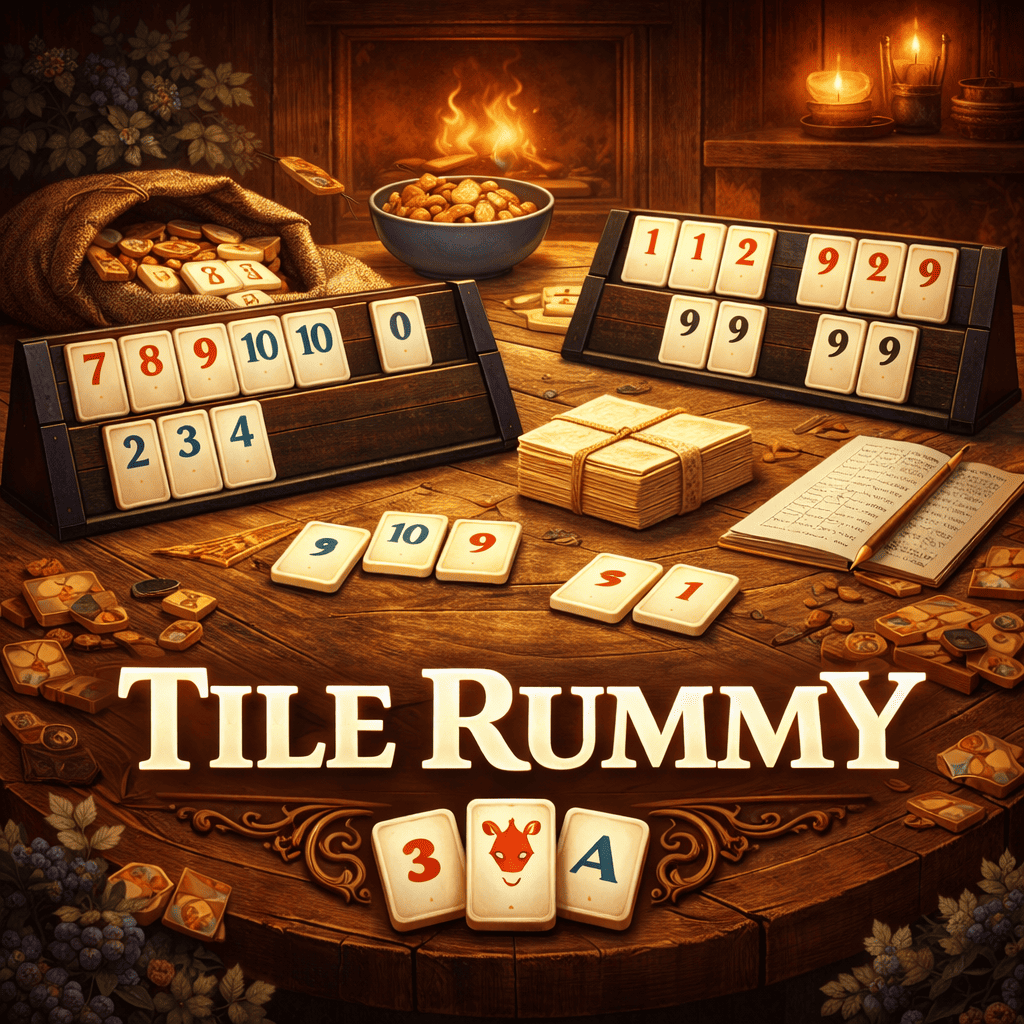
Tile rummy is the generic name for the Rummikub-style game: 106 numbered tiles, initial 30-point meld, and free rearrangement of the table once you are in. The version on Arcadia follows those classic rules against AI opponents.
Which is easier to learn?
Dominoes — match a pip on either open end and you know the game. Tile rummy adds the 30-point initial meld and table rearrangement, which takes a few hands to use well rather than just legally.
Do both games use jokers?
Tile rummy does: two jokers that stand in for any tile and get reclaimed by sharp players mid-rearrangement. Standard block dominoes has no wildcards — every one of the 28 tiles is exactly what it shows.
How do you win each game?
Both end when a player empties their hand. In dominoes you can also win a locked board by holding the fewest pips; in tile rummy going out ends the round and opponents count the tiles left on their racks against them.
Which is better for two players?
Dominoes is built for two and loses nothing head-to-head. Tile rummy works with two but shines with three or four, when the shared table grows fastest and rearrangements get most creative.

MAIN MENU
PvP Games
 Battleship
 Crazy Eights
 Dots & Boxes Blitz
 Gomoku
 Ludo
Ludo Quoridor
 Snakes & Ladders
 Yahtzee
Free Games
 Alquerque
 Backgammon
 Bagh-Chal
 Balut
Balut Battle for TokyoBattleship
 Bingo
Bingo Brick Breaker
 Bridge
 Bunco
Bunco Callbreak
 Checkers
 Chess
Chess ChompCrazy Eights
 Cribbage
 Dara
Dara Derby Dash
 DominoesDots & Boxes Blitz
 Durak
Durak Emberdeep
 Euchre
 Fanorona
 Farkle
 Fox and Geese
 Fox and Hounds
 Generala
 Gin Rummy
 Go / WeiqiGomoku
 Hazard
 Hearts
 Hex
Hex Higher or Lower
 Hnefatafl
 Hounds and Jackals
 Indian Rummy
 Jungle
 Ludus Latrunculorum
 Liar's DiceLudo
 Mahjong Solitaire
 Mancala
 Minesweeper
 Nim
Nim Nine Men's Morris
 Onitama
 Patolli
 Peg Solitaire
 Pentago
 Pente
Pente Pig
Pig PylosQuoridor
 Reversi
 Royal Game of Ur
 Scratch Cards
 Seega
Seega Senet
Senet Shax
Shax Ship, Captain, Crew
 Shut the Box
 Sixteen Soldiers
 SnakeSnakes & Ladders
 Klondike Solitaire
 Space Blaster
 Spades
 Sugar Pop
 Sungka
 Tangram
 Tile Rummy
 Tower
Tower Truco
Truco War
War Word Spy
 XII ScriptaYahtzee
NEED HELP?