Mahjong vs Peg Solitaire: Which Solo Puzzle to Play?
The Verdict
Two of the best solo board puzzles ever made, at different sizes. Peg solitaire is compact and brutal: 32 pegs, jump to clear, and one careless early jump dooms the board — a full attempt takes five minutes. Mahjong solitaire is the longer unwind: 10–15 minutes of freeing and matching 144 tiles, where the skill is unlocking layers in the right order. Choose pegs for a sharp, retryable challenge; choose mahjong for a session.
Side by Side
| Mahjong Solitaire | Peg Solitaire | |
|---|---|---|
| Players | 1 | 1 |
| Pieces | 144 tiles | 32 pegs (English board) |
| Attempt length | 10–15 min | 3–5 min |
| Luck factor | Layout shuffle matters | None — same start every time |
| Skill | Unlock-order planning | Move-sequence planning |
| Rules complexity | ~1 min to learn | ~1 min to learn |
| Solvability | Most layouts, with care | Fully solved by mathematicians — still hard |
| Origins | 1980s, from Chinese tiles | France, documented 1697 |
One fixed puzzle versus a fresh layout
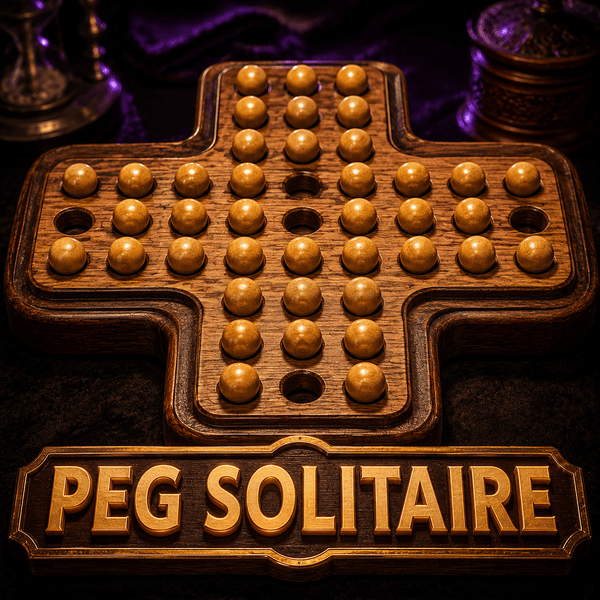
Peg solitaire starts identically every time: 32 pegs, centre hole empty, jump pegs over neighbours to remove them and finish with one peg — ideally in the centre. Because the start is fixed, mastery is real: sequences you learn keep working. Mahjong solitaire reshuffles its 144 tiles into the layout each game, so every attempt is a new terrain read — which stacks to dig into first, which long rows threaten to jam.
How they punish mistakes
Peg solitaire punishes immediately and permanently — a wrong early jump strands pegs in corners no sequence can rescue, and you discover it three moves later. Mahjong is gentler but sneakier: the game happily lets you clear easy pairs until you discover the last two matching tiles are stacked on top of each other. Both teach the same lesson — think ahead of your hands — at very different tempos.
Which fits your break?
With five minutes, take peg solitaire: an attempt fits inside a coffee refill and the itch to fix your last mistake is instant. With a quarter of an hour and a wish to switch your brain to quiet mode, mahjong is the better companion — methodical, visually satisfying, and finished layouts genuinely feel earned. They rotate well: pegs to wake up, tiles to wind down.
Pick Mahjong Solitaire if…
- you want a longer, meditative session
- you like reading a fresh layout each game
- you enjoy visual matching over abstract logic
- you have 10–15 minutes
Pick Peg Solitaire if…
- you want a hard puzzle in five minutes
- you like mastering a fixed challenge
- you want zero luck in your solo game
- you enjoy instant retries after a mistake
FAQ
Is mahjong solitaire winnable every time?
No. Depending on the shuffle, some layouts are unwinnable no matter how well you play, and others become unwinnable after a careless match. Preferring matches that unlock buried tiles keeps far more layouts alive.
What is the goal of peg solitaire?
Clear the board by jumping pegs over adjacent pegs until only one remains — the classic perfect finish leaves that last peg in the centre hole. On the standard English board that takes at least 31 jumps.
Which is harder?
Peg solitaire, move for move: the fixed board has been fully analysed and a perfect solve still demands precise sequencing. Mahjong is more forgiving per move but adds layout-reading that keeps every game different.
Are these games good for your brain?
Both exercise planning and working memory in short, low-stress sessions: pegs drills move sequencing, mahjong drills spatial look-ahead and patience. Neither requires any arithmetic or vocabulary, which is why both cross ages so well.
Can I play both free on Arcadia?
Yes — both run free in your browser with no download or sign-up, and both restart instantly when an attempt goes wrong.

MAIN MENU
PvP Games
 Battleship
 Crazy Eights
 Dots & Boxes Blitz
 Gomoku
 Ludo
Ludo Quoridor
 Snakes & Ladders
 Yahtzee
Free Games
 Alquerque
 Backgammon
 Bagh-Chal
 Balut
Balut Battle for TokyoBattleship
 Bingo
Bingo Brick Breaker
 Bridge
 Bunco
Bunco Callbreak
 Checkers
 Chess
Chess ChompCrazy Eights
 Cribbage
 Dara
Dara Derby Dash
 DominoesDots & Boxes Blitz
 Durak
Durak Emberdeep
 Euchre
 Fanorona
 Farkle
 Fox and Geese
 Fox and Hounds
 Generala
 Gin Rummy
 Go / WeiqiGomoku
 Hazard
 Hearts
 Hex
Hex Higher or Lower
 Hnefatafl
 Hounds and Jackals
 Indian Rummy
 Jungle
 Ludus Latrunculorum
 Liar's DiceLudo
 Mahjong Solitaire
 Mancala
 Minesweeper
 Nim
Nim Nine Men's Morris
 Onitama
 Patolli
 Peg Solitaire
 Pentago
 Pente
Pente Pig
Pig PylosQuoridor
 Reversi
 Royal Game of Ur
 Scratch Cards
 Seega
Seega Senet
Senet Shax
Shax Ship, Captain, Crew
 Shut the Box
 Sixteen Soldiers
 SnakeSnakes & Ladders
 Klondike Solitaire
 Space Blaster
 Spades
 Sugar Pop
 Sungka
 Tangram
 Tile Rummy
 Tower
Tower Truco
Truco War
War Word Spy
 XII ScriptaYahtzee
NEED HELP?