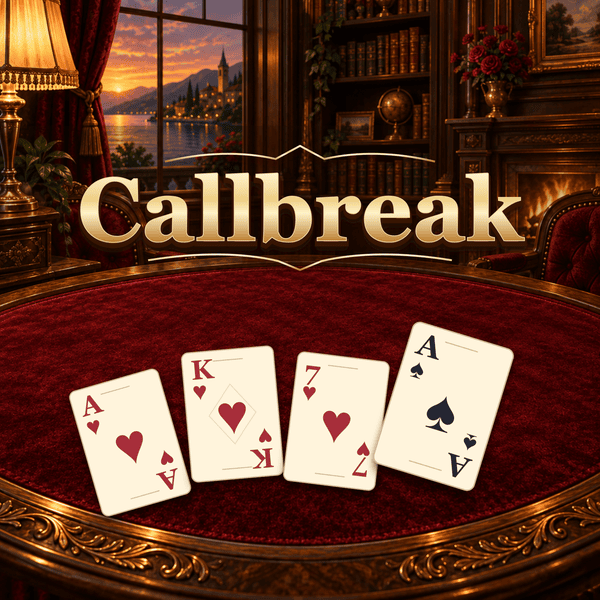
Callbreak - Rules, History & Strategy Guide
Learn how Callbreak works, why spades are always trump, and how bidding, the obligation to play higher and tenth-point overtricks decide a five-round match.
Reviewed & updated
History & Origins
Callbreak is a trick-taking game played widely in Nepal, India and Bangladesh. It is also known as Call Bridge, and in parts of India as Lakdi or Lakadi. Regional house rules differ, so two players from different regions can describe the same game slightly differently.
It sits in the same family as Spades: four players, thirteen cards each and spades as permanent trump. The differences matter though. Callbreak is played individually rather than in partnerships, it runs a fixed number of rounds, and it adds the rule that makes it distinctive: if you can beat the highest card of the led suit, you must.
How to Play
In Arcadia's version you play five rounds against three computer opponents, with every player scoring for themselves.
- All 52 cards are dealt to four players, thirteen each. Dealing, bidding and play run counterclockwise.
- Each player bids once, a whole number from 1 to 13. There is no second round and no pass.
- Follow the led suit if you can. If you hold a higher card in that suit than the highest one played, you must play a higher card.
- That obligation lifts once the trick has been trumped: then following suit is enough.
- With none of the led suit, play a spade that beats every spade in the trick if you have one; otherwise any card.
- Make your bid to score it plus 0.1 for every extra trick. Miss it and the bid is subtracted. The highest total after five rounds wins.
Strategy Tips
- Count your likely winners before bidding: high cards in side suits, the length of your spades and short suits that let you trump early.
- A player who follows with a low card may simply hold nothing higher. That inference changes once a spade has been played, because then the obligation to head the trick is gone.
- A low spade wins tricks while no other trump has appeared. Saving the high ones for later rounds is often worth more than taking a trick you did not need.
- Secure your own bid first. After that an extra trick is worth only a tenth of a point, while stopping an opponent from making their bid costs them the whole bid.
Variations
Callbreak varies by region. Some tables play four rounds, some nine; some allow a bid of zero, some settle ties differently. Arcadia plays one fixed set of rules: five rounds, bids from 1 to 13, the obligation to play higher, and 0.1 per overtrick.
The closest relative is Spades, which is played in partnerships and uses nil bids and bag penalties. Neither appears here.
Play Callbreak on Arcadia
Play Callbreak free on Arcadia against three AI opponents at Easy, Medium or Hard.
Quick Answers
Are spades always trump in Callbreak?
Yes. Spades are permanent trump in every round. There is no bidding for trump and no turned card.
Must I play a higher card if I can follow suit?
Yes, as long as the trick has not been trumped. If you hold a higher card in the led suit than the highest one played, you have to play one of them. Once someone has trumped a trick led in another suit, following suit is enough.
How are extra tricks scored?
Meeting your bid scores the bid plus 0.1 for each trick above it, so a bid of 3 with 5 tricks scores 3.2. Missing the bid subtracts it in full.
Is Callbreak the same as Call Bridge or Lakdi?
They are names for the same game in different places. Regional rules vary; Arcadia plays the fixed set described above.
Related Games On Arcadia
Related Guides

MAIN MENU
PvP Games
 Battleship
 Crazy Eights
 Dots & Boxes Blitz
 Gomoku
 Ludo
Ludo Quoridor
 Snakes & Ladders
 Yahtzee
Free Games
 Alquerque
 Backgammon
 Bagh-Chal
 Balut
Balut Battle for TokyoBattleship
 Bingo
Bingo Brick Breaker
 Bridge
 BuncoCallbreak
 Checkers
 Chess
Chess ChompCrazy Eights
 Cribbage
 Dara
Dara Derby Dash
 DominoesDots & Boxes Blitz
 Durak
Durak Emberdeep
 Euchre
 Fanorona
 Farkle
 Fox and Geese
 Fox and Hounds
 Generala
 Gin Rummy
 Go / WeiqiGomoku
 Hazard
 Hearts
 Hex
Hex Higher or Lower
 Hnefatafl
 Hounds and Jackals
 Indian Rummy
 Jungle
 Ludus Latrunculorum
 Liar's DiceLudo
 Mahjong Solitaire
 Mancala
 Minesweeper
 Nim
Nim Nine Men's Morris
 Onitama
 Patolli
 Peg Solitaire
 Pentago
 Pente
Pente Pig
Pig PylosQuoridor
 Reversi
 Royal Game of Ur
 Scratch Cards
 Seega
Seega Senet
Senet Shax
Shax Ship, Captain, Crew
 Shut the Box
 Sixteen Soldiers
 SnakeSnakes & Ladders
 Klondike Solitaire
 Space Blaster
 Spades
 Sugar Pop
 Sungka
 Tangram
 Tile Rummy
 Tower
Tower Truco
Truco War
War Word Spy
 XII ScriptaYahtzee
NEED HELP?